
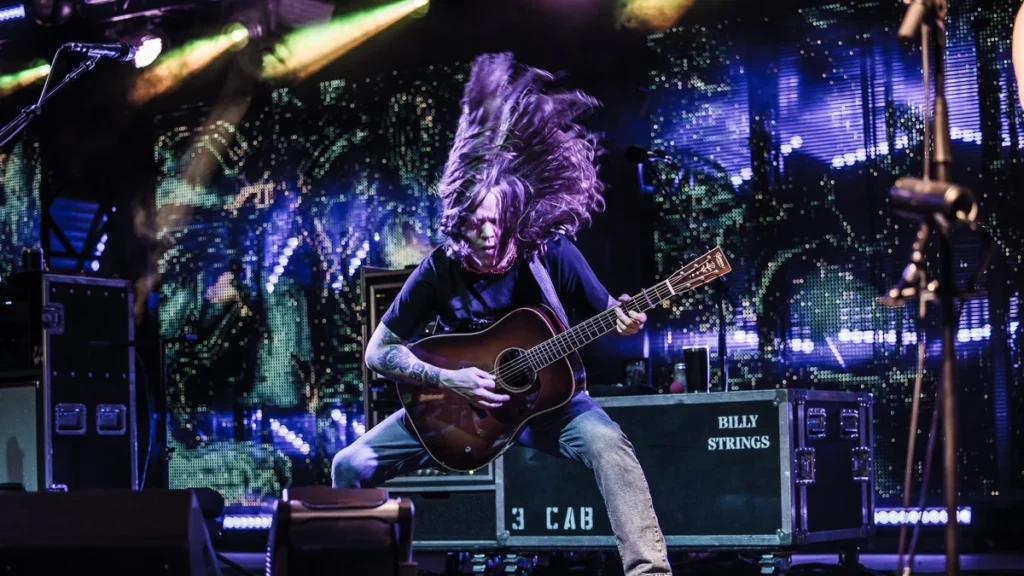
Billy Strings was raised on Doc Watson, Bill Monroe, Ralph Stanley, Earl Scruggs and Del McCoury records, handed to him by his stepfather. Del McCoury sings on his new album.
So Much for Goodbyes came out today through Reprise, digitally, on CD and as a two-disc LP. It is his fifth studio album, it runs seventy-five minutes and twenty-nine seconds across sixteen tracks, and it was co-produced by T Bone Burnett.
Seventy-Five Minutes Is a Double Album
The length is the first decision worth examining. Seventy-five minutes will not fit on a single LP, which is why it ships as two discs, and that is not an accident of the tracklist — it is a format choice made at the point of sequencing.
Bluegrass albums are traditionally short. The music is built on tight arrangements and fast turnarounds, and a record that runs past an hour is asking for a level of sustained attention the genre rarely demands.
The tracklist bears out the intent. Five songs run past five minutes and two go beyond six and a half, including “I Wish I Wanted To” at 6:45 and “Lucid Daydream” at 6:38 — lengths that come from a jam-band instinct rather than a bluegrass one.
That instinct is well documented in his case. Strings is a Grateful Dead, Phish and Widespread Panic listener as well as a Bill Monroe one, and the extended tracks are where the two halves of his listening meet.
The Producer Who Made Raising Sand
Bringing in T Bone Burnett as co-producer is the loudest signal on the record.
Burnett produced the O Brother, Where Art Thou? soundtrack in 2000, the record that made old-time American string music a mainstream commercial proposition, and won a Grammy for it. He also produced Raising Sand in 2007, the album that put Alison Krauss’s bluegrass alongside Robert Plant’s blues rock — an experiment in genre collision that could easily have failed and instead swept the Grammys.
His wider list runs through Gillian Welch, Los Lobos, John Mellencamp, Elton John and Ringo Starr, plus soundtrack work on Cold Mountain, Walk the Line and Crazy Heart. He began as a guitarist in Bob Dylan’s band in the 1970s.
That is a producer with a specific, repeated speciality: taking American roots music and presenting it to an audience larger than the one it came from, without stripping out what made it worth presenting. Hiring him is a statement about ambition rather than about sound.
It also puts a marker down about the follow-up problem. Highway Prayers, the 2024 album this one succeeds, won the Grammy for Best Bluegrass Album in 2026 — his third in that category after Home in 2021 and Live Vol. 1 in 2025. Following three wins with the same approach would be the safe move.
Instruments Bluegrass Does Not Use
The personnel list is where the record makes its argument. Strings’ band appears as expected: Billy Failing on banjo, Royal Masat on bass, Jarrod Walker on mandolin and Alex Hargreaves on fiddle, all singing.
Then the additional musicians. Paul Franklin plays pedal steel. Mickey Raphael plays bass harmonica. Alwyn Robinson plays drums.
None of those belong to bluegrass as Bill Monroe defined it. The genre is an acoustic string band — guitar, banjo, mandolin, fiddle, upright bass — and the absence of drums in particular is close to a founding rule, because the rhythm is supposed to come from the mandolin chop and the banjo roll rather than from a kit.
Pedal steel is a country instrument, not a bluegrass one. Bass harmonica is barely anybody’s instrument, though Raphael’s long association with Willie Nelson’s band makes the choice legible.
Adding all three at once, on an album made with a producer known for widening audiences, is a coherent set of decisions rather than three separate ones.
A Guest List Assembled From His Own Record Collection
The backing vocals are the detail that gives the album its shape. Alison Krauss, Del McCoury, Dan Tyminski, Tim O’Brien, Chris Henry and Lindsay Lou all sing on it, with Bryan Sutton adding guitar.
McCoury’s presence is the one that carries weight. Strings’ stepfather, Terry Barber — an amateur bluegrass musician he regards as his father — introduced him as a child to Doc Watson, Del McCoury, David Grisman, Bill Monroe, John Hartford, Ralph Stanley, Earl Scruggs and Larry Sparks.
Getting one of those names onto your own record is a specific kind of career milestone, and it is not merely sentimental. A backing vocal from McCoury is an endorsement legible to exactly the traditional audience most likely to be sceptical about the drums.
Krauss’s appearance works the same way from the other direction. She is the artist Burnett previously paired with a rock singer, and her voice on a record he co-produced connects this album to the last time he tried something similar.
Between them, the guests function as cover. An artist bringing a drum kit and a pedal steel into bluegrass has a much easier argument to make with Del McCoury and Alison Krauss standing behind him.
Where the Songs Appear to Sit
The titles suggest a record that has not abandoned the tradition it is stretching. “Bluewater Breakdown” names a standard bluegrass form. “I Like Train Songs” is close to a genre in-joke, trains being one of the music’s oldest recurring subjects.
Others read darker. “Mill Town Flood” belongs to the disaster-ballad lineage, “Wrestling an Angel” to the gospel one, and “Lay Me Down” and “Remember to Cry” to the mortality-facing tradition that runs through the whole music.
The closer is “Debra’s Waltz”, and the album’s artwork is credited to Debra Apostol — Apostol being the surname Strings was born under, before an aunt gave him his stage name after watching him play several traditional instruments.
Ending a record made with a famous producer on a waltz named after a family member, with family artwork attached, is a way of keeping ownership of it.
The Route Here Was Not a Bluegrass One
The biography behind all this is harder than the music usually suggests. Born William Lee Apostol in Lansing, Michigan in 1992, Strings lost his biological father to a heroin overdose at two, and his parents later became addicted to methamphetamine. He left home at thirteen and went through a period of hard drug use himself before the family got sober.
He also played in hard rock and indie rock bands as a teenager, and lists Jimi Hendrix, Johnny Winter, Black Sabbath, Pearl Jam and Primus among his influences alongside the bluegrass canon.
That combination explains a great deal about how his records sound and why they reach people who do not otherwise listen to this music. Our piece on why folk revivals keep happening covers the cycle he has arrived in the middle of.
Three Grammys in five years is an unusual rate, and the temptation after that would be to keep making the record that won them. This one runs seventy-five minutes, has a drummer on it and was made with the producer of O Brother. Whatever else it is, it is not the safe option.
So Much for Goodbyes is out now on Reprise.
About The Author

 Why the Glockenspiel Survived: Bed by Stacy Henle and the Craft of a Quiet Folk Single
  Maybe Magic by Ryan Sweezey and a Decade of Unfinished Songs: The Long Version
  Where Deep Blue Sea Came From: Kadi Beth and a Mayday Call Over Dark Water
  Backyard Getaway by Emily Fraser, a Pop-Country Escape: The Long Version
  Why New Orleans Blues Rock Survived the Move to Switzerland on Rising by Jeb Rault
  Where I Asked Jesus & He Said No Came From: The Martha Groves Perry and Pat Thrall Protest Single