
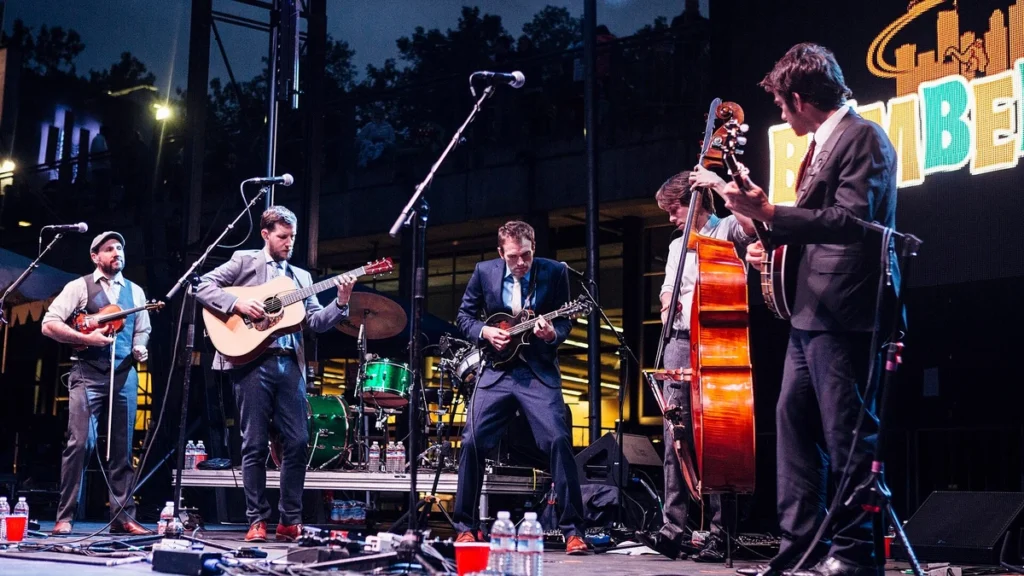
Punch Brothers performing at Bumbershoot in 2015, before Brittany Haas joined the band.
Punch Brothers performing at Bumbershoot in 2015, before Brittany Haas joined the band.
Chris Thile has one of the most recognisable voices in American string music. On The Unsung Adventures of Punch Brothers he does not use it once. The band’s seventh album, released on 24 July through Nonesuch Records, is the first in their two decades together with no singing on it at all.
They were clear-eyed about what that means commercially. The band called the record their “most daring, least marketable escapade to date”, a description Bluegrass Today carried when the album was announced. It is an unusually honest thing for a group to say about its own release, and it turns out to be accurate on both counts.
What Happens When the Voice Is Removed
Punch Brothers have always been a band whose instrumental writing outran its songs. Removing the vocal does not therefore subtract a layer so much as remove a distraction. The five parts — Thile’s mandolin, Chris Eldridge’s guitar, Noam Pikelny’s banjo, Paul Kowert’s bass and Brittany Haas’s fiddle — become the entire argument rather than the setting for one.
Kristopher Weiss, reviewing it for Jambands, found the record “the same and quite different at the same time”, and reached for a good image to explain it: a comfy, well-worn pair of sonic shoes fitted with new soles. That captures the specific pleasure here. Nothing about the band’s identity has changed. The thing it is doing with that identity has.
Brittany Haas Makes Her Studio Debut
Haas joined in 2023, the band’s only personnel change since it formed in 2006, and this is the first time she has recorded with them. Putting a new member’s debut on an all-instrumental album is either reckless or extremely confident, because there is nowhere for a fiddle to hide when there is no vocal line to support.
The opening track, “New Bike”, was the single, and it is built to introduce her. Folk Alley’s Henry Carrigan describes muted strums from mandolin and guitar setting a counterpoint for the fiddle, with the tempo shifting through interludes. It gives Haas the melodic lead from the first bar rather than easing her in behind the established players.
Choosing that as the lead single is the clearest signal of intent the band sent. A group introducing a new member usually releases the track that sounds most like the last record, to reassure. Punch Brothers released the one that most obviously does not, and it is fiddle-led. The message to an existing audience is that the change is the point, not something to be managed.
It also resolves a question the band had been carrying since 2023. A fiddle player joining an established string band inherits a chair with a defined shape, and the easy path is to fill it as the predecessor did. Everything about the way this record is arranged suggests nobody wanted that. The parts were rewritten around the player rather than the player fitted to the parts.
Eleven Pieces, Some of Them Much Older
The album runs eleven pieces, and not all of them are new. “Solve Knut (untied)” is an arrangement of a Norwegian air, carried on lilting mandolin and ringing banjo. “Song of the Water Kelpie (unsung)” is traditional too, and Carrigan’s five-star review calls it ethereal and idyllic.
Setting traditional material beside original composition is the oldest move in this music, and it does something specific on a record with no words. A listener who cannot follow a lyric still needs orientation, and a tune that has existed for two centuries supplies it. The old pieces act as landmarks between the newer, stranger ones.
The Norwegian air is the more revealing inclusion. Bluegrass instrumentation descends in part from Scots-Irish and Nordic fiddle traditions carried into Appalachia, so arranging a Norwegian melody for banjo and mandolin is not a novelty import. It is following the line back past the point where the American form is usually said to begin, and letting the modern ensemble play something its own ancestors would recognise.
“Le Ruisseau” works the opposite way, using the ensemble to imitate a physical thing — a country stream, tumbling and then quiet. Programme music of that kind is rare in bluegrass, where tunes are usually named after places, people or dances rather than described scenes. Without a lyric to carry an image, the instruments have to do the depicting themselves, and the album repeatedly takes that opportunity.
The Strange End of the Record
“Saturn: Pogo Ball of the Gods” is where the album stops being polite. Carrigan describes it as playful and jaunty with dissonant strains running under it; Weiss files it, along with the Water Kelpie tune, among the album’s more challenging moments. “Found in a Frozen Fog” opens somber and mournful before breaking into a rush that Folk Alley compares to Emerson, Lake and Palmer, which is not a comparison bluegrass records usually invite.
There is also “porthole”, an eleven-second interlude, and “Le Ruisseau”, which imitates the tumbling and settling of a country stream. “Descend, O Diamondback!” sits nearer conventional bluegrass. The closer, “New Book”, is a bluegrass scamper written as a deliberate bookend to “New Bike”.
Why This Is a Bluegrass Record and Not a Chamber One
It would be easy to file an instrumental album with dissonance, a Norwegian air and a prog-rock comparison somewhere outside bluegrass. That would be a mistake. The instrumentation is the classic five-piece string band, the interplay follows bluegrass conventions about who takes a break and when, and the rhythmic drive underneath even the strangest passages is the one Bill Monroe’s ensemble established.
What has changed is the material those conventions are applied to. This is the same distinction that separates a traditionalist from a revivalist elsewhere in the genre — the tools stay fixed and the repertoire moves. Billy Strings approached the problem from the opposite direction on his recent record, keeping the songs conventional and bringing in outside producers to reshape the sound.
The Least Marketable Record They Could Have Made
Twenty years in, with a Grammy history and a settled audience, Punch Brothers had every incentive to make the record their listeners expected. They made an instrumental album instead, on which the best-known voice in the group is silent, and released it in a market that rewards vocal hooks above everything.
The economics of that decision are worth stating plainly, because the band did. Instrumental music is disadvantaged at almost every stage of modern distribution: it is harder to playlist, it gets less radio, it cannot be excerpted into a lyric video, and it loses the search traffic that a song title attached to words reliably earns. “Least marketable” is not modesty. It is an accurate forecast.
Against that, a working band has one asset that does not depreciate, which is the reason people buy tickets. Punch Brothers tour constantly, and an audience that comes for ensemble playing is exactly the audience an instrumental record serves best. Read that way, the album is less a commercial sacrifice than a decision to make a record for the room they actually play to rather than the platform they are distributed on.
Carrigan called it clearly one of the best albums of the year so far. Weiss concluded that there is reward in the risk. Both are right, and both verdicts depend on the same thing: a band that has been playing together long enough to know exactly what it sounds like, and secure enough to spend that knowledge on something with no obvious commercial return.
The title tells you they knew. These are unsung adventures in both senses — no voices, and no expectation of applause.
About The Author

 Maybe Magic by Ryan Sweezey and a Decade of Unfinished Songs: The Long Version
  Where Deep Blue Sea Came From: Kadi Beth and a Mayday Call Over Dark Water
  Backyard Getaway by Emily Fraser, a Pop-Country Escape: The Long Version
  Why New Orleans Blues Rock Survived the Move to Switzerland on Rising by Jeb Rault
  Where I Asked Jesus & He Said No Came From: The Martha Groves Perry and Pat Thrall Protest Single
  Brandi Carlile’s Ted Lasso Theme Is the First Sung by a Woman