
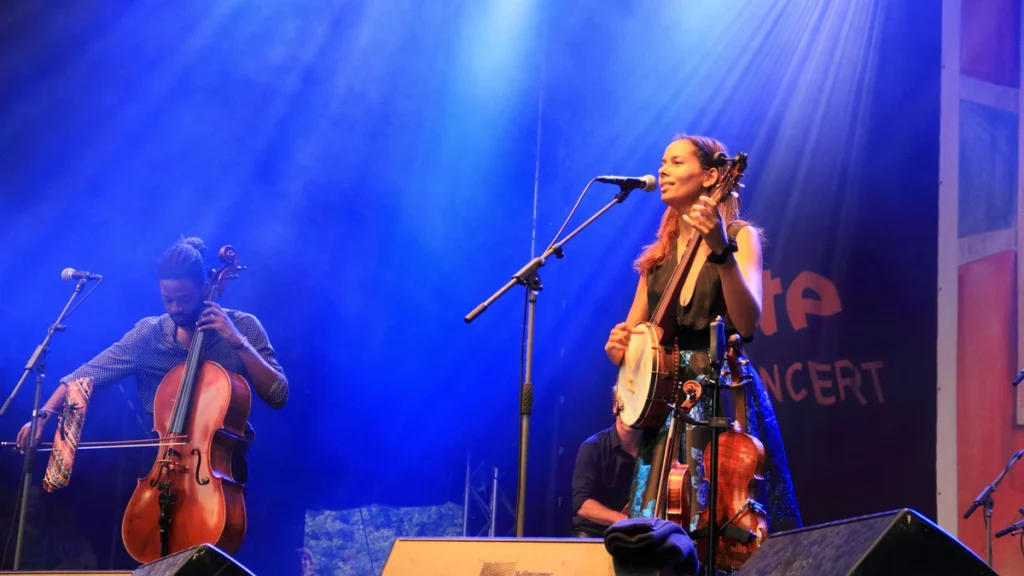
Rhiannon Giddens has spent twenty years arguing that American music was made by people from everywhere. Her new album is that argument assembled as a band.
Hope Is the Thing With Feathers arrives on 18 September through Nonesuch Records, ten songs recorded live at a house in Breaux Bridge, Louisiana.
Four Places in One Room
Giddens has put the thesis plainly. “Louisiana, the Congo, Italy, the Carolinas — all of these influences and people coming together to make something: that is American music,” she said. “It’s how American music came to be, and that was the original thought of creating a band with the musicians that I’ve been playing with for years, and featured on this album.”
The personnel bear it out exactly. Giddens takes lead vocals, minstrel banjo and fiddle. Jason Sypher, her longtime bassist, plays bass. Francesco Turrisi, an Italian multi-instrumentalist, plays accordion and percussion. Niwel Tsumbu, a Congolese artist, plays guitars. Dirk Powell, from Louisiana, plays multiple instruments.
What makes the claim more than a diversity statement is that these are not guests. Each has been playing with Giddens for years, and the band was assembled from the people already in her working life rather than cast to illustrate a point.
Turrisi in particular has been a long-standing partner — the two made both There Is No Other and They’re Calling Me Home together in 2021.
The minstrel banjo is the other detail worth pausing on. It is an instrument with a genuinely uncomfortable history, and Giddens has spent her career reclaiming exactly that lineage — the African origins of the banjo and the Black string-band tradition that American popular music was built from.
Her Sister, Her Nephew and Her First Bandmate
The rest of the band is family, in two senses. Giddens’ sister Lalenja Harrington appears, as does her nephew Justin Harrington, who plays bones — one of the oldest percussion instruments in the American tradition.
Justin Robinson is on vocals and fiddle. He was Giddens’ very first bandmate and a fellow North Carolinian, from the Carolina Chocolate Drops, the group she co-founded and that won a Grammy.
Dirk Powell’s daughter Amelia Powell plays acoustic guitar and sings, and Charly Lowry contributes vocals and percussion.
Two families and a first bandmate on one record is a specific kind of statement about continuity. The press material notes that the album in many ways tells the story of the last twenty years of Giddens’ life, and the credits are the most direct evidence of it.
The idea underneath is not sentimental. Old-time and string-band music was made by families and neighbours before it was made by professionals, and assembling a record that way is a methodological choice rather than a nostalgic one. Our piece on what Americana actually covers examines the same territory.
Recorded Live, With Stomping
The method matches the personnel. The album was intentionally recorded live with no frills and few overdubs — described as pure and essential music, capturing the feeling of community and clarity and the power of creating together.
Giddens has said recording live was crucial in order to bring the listener into the centre of the room. That is a harder brief than it sounds: a live take with ten musicians has no route to correction, and every decision is made once.
The best detail is the smallest. Giddens says she cannot play without stomping, and the stomping is audible on the record — the sort of thing multitrack recording exists to remove and which a live session preserves whether anyone wants it or not.
That single fact tells you what the whole approach is for. A foot on a floorboard is not a performance; it is evidence of a body in a room, and a record made to put a listener in that room needs it.
Made in the Gaps of Two Tours
The sessions happened at The Cypress House in Breaux Bridge, Louisiana, fitted inside North American tours across 2024 and 2025.
Recording an album between tour dates is normally a compromise, and it produces records assembled from fragments. Here it appears to have been the enabling condition: a band already touring together is a band already playing together, which is the only way ten people cut ten songs live.
Breaux Bridge is in the heart of Cajun and Creole Louisiana, and Dirk Powell — who co-produced with Giddens, and engineered and mixed the album — is from there. Recording in a bandmate’s home region rather than a commercial studio keeps the whole project inside the relationships it is about.
Powell doing the production, engineering and mixing himself is the last piece of that logic. There is no outside technician interpreting what the room sounded like; the person who mixed it was playing in it.
The economics of that arrangement are worth noting too. Studio time for ten musicians across multiple sessions is prohibitive at commercial rates; a house belonging to a bandmate, used between tour dates, is how a record this large gets made at all.
It also removes the clock. A booked studio imposes a deadline that shapes what gets attempted, and a room you can return to whenever the tour passes through does not.
Ten Songs About People Together
The stated subject follows from the method. The collection was inspired by the beauty of people coming together and drawing strength from each other, which is close to a description of how it was recorded.
That alignment is rarer than it should be. Records about community are frequently made in isolation, one part at a time, by people who never meet; this one was made by the people it is about, in the same room, at the same moment.
Ten songs is also a restrained length for a project with this much going on. A band of this size and range could fill an hour easily, and stopping at ten suggests the sequencing was decided by what worked rather than by what existed.
Where This Sits in Her Career
Giddens is a Pulitzer and Grammy winner and one of the most decorated musicians working in American roots music. Born in Greensboro, North Carolina in 1977, she co-founded the Carolina Chocolate Drops and has released solo records including Tomorrow Is My Turn, Freedom Highway and You’re the One.
Her work outside her own albums covers extraordinary range: the T Bone Burnett-produced New Basement Tapes project, which set newly discovered Bob Dylan lyrics to music, a song for the video game Red Dead Redemption 2, and the opera Omar.
Against that catalogue, a live-recorded album made with the same musicians she has played with for years is a deliberate narrowing. It is not an expansion into a new form; it is a record of what she has been doing all along.
Ten songs, one house, no overdubs to speak of and a band drawn from four places. If the argument about American music holds anywhere, it should hold there.
Nonesuch is the right label for it. The imprint has spent decades releasing exactly this kind of record — music that sits between traditions and would not survive a market-driven categorisation — and Giddens has been signed there through most of her solo career.
The test in September will be whether a live recording made in a house can hold an audience used to records built for clarity. On the evidence of the personnel and the method, that is precisely the question the album was made to ask.
Hope Is the Thing With Feathers is out on 18 September through Nonesuch Records.
About The Author

 Maybe Magic by Ryan Sweezey and a Decade of Unfinished Songs: The Long Version
  Where Deep Blue Sea Came From: Kadi Beth and a Mayday Call Over Dark Water
  Backyard Getaway by Emily Fraser, a Pop-Country Escape: The Long Version
  Why New Orleans Blues Rock Survived the Move to Switzerland on Rising by Jeb Rault
  Where I Asked Jesus & He Said No Came From: The Martha Groves Perry and Pat Thrall Protest Single
  Brandi Carlile’s Ted Lasso Theme Is the First Sung by a Woman