
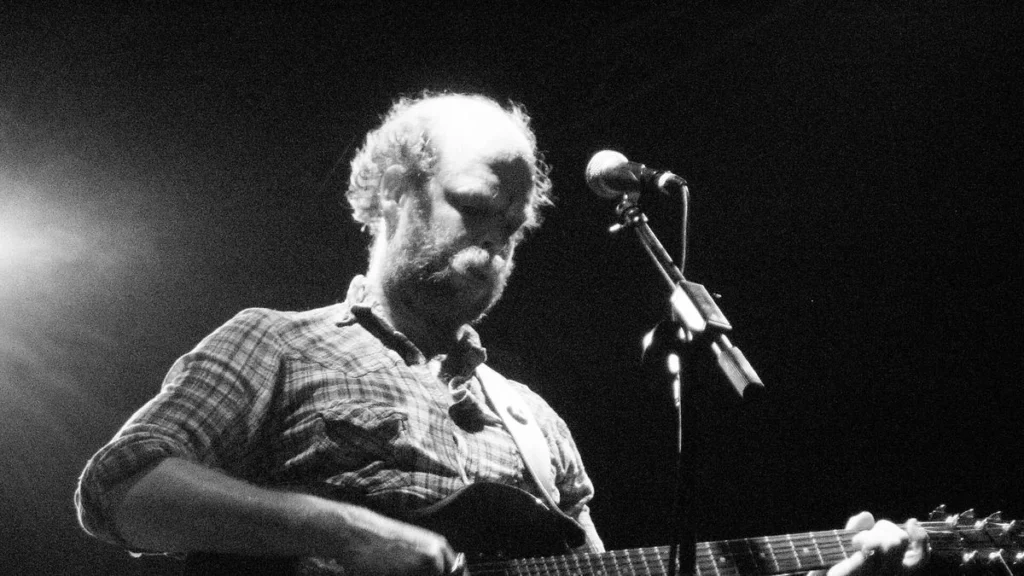
Will Oldham performing as Bonnie “Prince” Billy in 2009.
Will Oldham performing as Bonnie “Prince” Billy in 2009.
The credits for We Are Together Again list seven singers besides Will Oldham. They also list a tuba, a bouzouki, a harp, a cornet, a five-piece string section and a man applying modular synthesis to a saxophone. For a writer whose reputation rests on sparse recordings of one voice and a guitar, that is a considerable crowd.
The album came out on 6 March through Domino in Britain and Europe and No Quarter in the United States, and is roughly the thirty-first Oldham has released as Bonnie Prince Billy. It was made close to home: recorded and mixed by Jim Marlowe at End of an Ear, in the Portland neighbourhood of Louisville, Kentucky, across spring 2025.
A Louisville Record, Made by Louisville People
The album’s own credits describe it as continuing a Louisville-first recording mandate, and the personnel bear that out. The three frontwomen of the local band Duchess — Tory Fisher, Lacey Guthrie and Katie Peabody — sing on it. Catherine Irwin of Freakwater, who appeared on Oldham’s Ease Down the Road a quarter of a century ago, is back.
Family runs through it too. Ned Oldham, Will’s brother, plays bass, which KLOF Mag notes is his first appearance on one of these records in about two decades. Ryder McNair, a cousin, wrote the string arrangements and plays piano.
Recording in your own city with your own people is a practical decision before it is a romantic one. It removes travel, scheduling and the per-day cost that forces a band to finish before the arrangements have settled, and it makes it possible to bring in a harpist for one song because she lives nearby.
A few pieces were captured elsewhere — additional recording came from a studio in County Clare in Ireland and another in New York — but the centre of gravity never leaves Kentucky. That is unusual for an artist at this stage, where the normal path runs towards Nashville or Los Angeles and a producer with a house band.
The Album Is Bookended by the Same Song
“Why Is the Lion” opens the record at six and a half minutes, and “Bride of the Lion” closes it at four. They are two readings of the same song with adjusted words. Thomas Blake, reviewing it for KLOF Mag, describes the opener as slow and decorated by Jacob Duncan’s flute, reaching towards baroque folk, with the closing version starker and the guitars pulling against the melody.
Framing an album this way is an old device and it does something specific here. A listener who reaches the last track has heard everything in between, so the second version lands as a report on the journey rather than a reprise. The lyrics changing slightly is the mechanism that makes the point.
It also tells you the record was sequenced rather than assembled. Ten songs that arrive in a deliberate order, opening and closing on the same melody, is a structure, and structures are what distinguish an album from a collection.
The Songs in the Middle
“Strange Trouble” carries what Blake calls one of Oldham’s prettiest melodies in years, with lyrics haunted by existential anxiety. “Hey Little” is fiddle-driven with a saxophone solo and Catherine Irwin singing, and Blake rates it among the truest songs about parenthood anyone is likely to hear.
“Vietnam Sunshine” sits somewhere adjacent to “You Are My Sunshine”, with brass that veers between mariachi and oompah and a chorus KLOF likens to John Prine. “(Everybody’s Got a) Friend Named Joe” runs on string quintet, bouzouki and Moog. “Davey Dead” pairs Erin Hill’s harp with Christopher Bush’s electronics processing Duncan’s saxophone.
The instrumentation is the joke and the substance at once. Almost every track introduces something that has no business on an alt-country record — a whistle, a tuba, a harp — and none of them are played for novelty. They are used the way a session player uses any instrument, to fill a specific hole in an arrangement.
Thomas Deakin is the clearest example of the method. He is credited with accordion, whistle, electric guitar, cornet, tuba, clarinet and vocals, which is less a session musician than a one-man wind section with a guitar. Hiring one player who covers seven instruments is how a record this ornate gets made in a neighbourhood studio rather than a symphony hall.
The strings work the same way. Ryder McNair arranged for five players — three violins, a viola and a cello — which is a real chamber group rather than a synthesiser patch, but small enough to fit in the room and the budget. The lavishness is carefully bounded.
Covering a Song He Had Already Covered
“Life Is Scary Horses” is a rewriting of “Horses”, a song by Sally Timms and Jon Langford that Oldham had recorded before. Timms sings on this version, which turns a cover into something closer to a joint authorship, and the arrangement puts elegant violin and a Celtic whistle over a restrained shuffle.
Its central line is the bleakest thing on the album: the human times have come and gone, and we must accept our rule is done. Delivered by two voices rather than one, over a light arrangement, it avoids the portentousness a solo reading would have risked.
This is Oldham’s characteristic move. Take a hard proposition, hand it to more people, and let the company do the work that a heavier arrangement would otherwise have to. It is the same instinct behind the album’s title.
Where Reviewers Disagree
The one substantive dispute concerns what this record is doing relative to The Purple Bird, the country album that preceded it by about a year. KLOF hears a return to folky singer-songwriter mode, sometimes confessional and sometimes gnomic. At The Barrier hears the polished approach continuing rather than a retreat to rawer production.
Both readings are defensible, and the reason is that the two axes have moved in different directions. The recording method stayed put — same city, same community, same producer relationship. The musical mode shifted away from straight country towards something more arranged and more communal.
At The Barrier’s summary — that the record has no right to be this good — captures the reaction better than any category does. Blake’s verdict was that it is some of Oldham’s best work, wide-eyed at the mysteries of the world but full of heart and hope.
Thirty-One Albums In
A catalogue this size stops behaving like a career and starts behaving like a habit. Oldham has released records at a rate that makes any individual one hard to position, and the usual consequence is that late albums get reviewed against an idea of the artist rather than on their own terms.
What protects this one is the cast. An album with seven other singers on it cannot be a self-portrait, and the arrangements keep handing the emotional weight to somebody else. That is a genuinely unusual thing for a songwriter thirty years into a solo project to do — closer in spirit to a band naming a record after its new members than to a veteran making a statement.
The liner note asks listeners to plant these songs into their soul’s brain, and describes the method: start small, continue small, like oak tree seeds. For a record with a string section and a tuba on it, that is either a contradiction or the most accurate description available.
About The Author

 Why the Glockenspiel Survived: Bed by Stacy Henle and the Craft of a Quiet Folk Single
  Maybe Magic by Ryan Sweezey and a Decade of Unfinished Songs: The Long Version
  Where Deep Blue Sea Came From: Kadi Beth and a Mayday Call Over Dark Water
  Backyard Getaway by Emily Fraser, a Pop-Country Escape: The Long Version
  Why New Orleans Blues Rock Survived the Move to Switzerland on Rising by Jeb Rault
  Where I Asked Jesus & He Said No Came From: The Martha Groves Perry and Pat Thrall Protest Single