
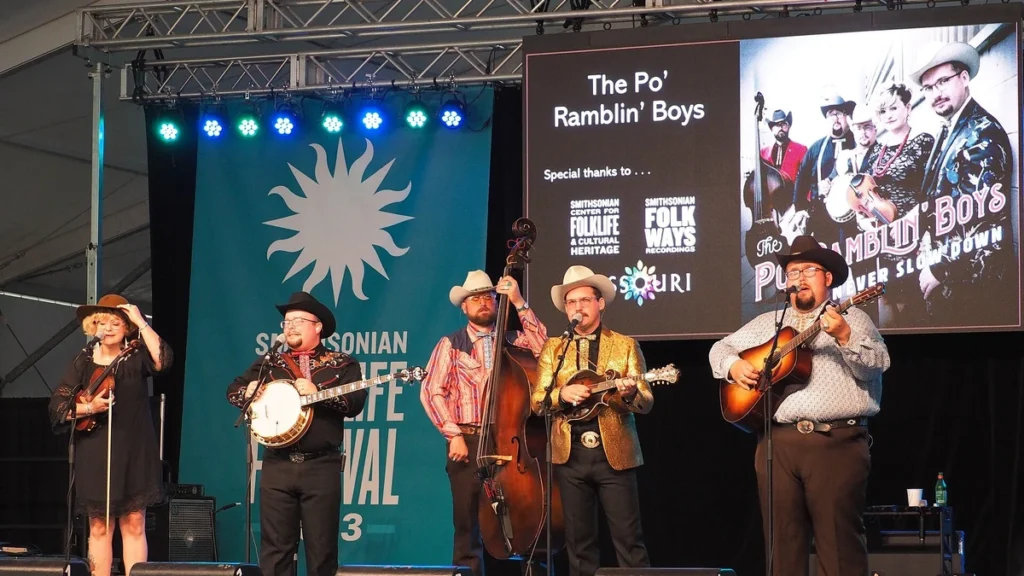
The Po’ Ramblin’ Boys performing at the Smithsonian Folklife Festival in 2023.
The Po’ Ramblin’ Boys performing at the Smithsonian Folklife Festival in 2023.
Most bands name an album after a song on it. The Po’ Ramblin’ Boys named theirs after two people. Welcome to the Club, out 21 August on Turnberry Records, is the first record made by the second line-up in the Tennessee group’s history, and the title is addressed to the men who joined it.
Guitarist John Gooding and fiddler Max Silverstein came in alongside the three co-founders — C.J. Lewandowski on mandolin, Jereme Brown on banjo and Jasper Lorentzen on bass. For a band that had run with one line-up for over a decade, replacing two chairs at once is a substantial event, and naming the record for it is a way of putting the change on the record rather than hoping nobody notices.
Twelve Years, Then Two New Chairs
The signing to Turnberry was announced in January 2026, after twelve years of performing. Bluegrass Today reported Lewandowski saying the label “has made incredible strides in the bluegrass world these past few years”, and that the band was eager to get into the studio with its new configuration.
Label head Keith Barnacastle returned the compliment in the language traditional bluegrass uses about itself: the band, he said, represents “the very heart of bluegrass — respect for tradition, unmatched musicianship”. That is boilerplate on paper, but in this case it describes an actual working method rather than a positioning statement.
Where the Sound Was Built
The band’s reputation was made at the Ole Smoky Moonshine distillery in Gatlinburg, Tennessee, playing daily. Repetition at that volume produces a specific kind of band: tight, unfussy, and built around harmony singing that has to carry over a room that is not listening in silence. The Stanley-style sound they are known for is a direct product of that apprenticeship.
It also explains why a line-up change matters more here than it would elsewhere. A band whose identity rests on ensemble blend rather than on a frontman cannot simply slot in replacements. Silverstein came to the fiddle chair from Bangor, Maine, by way of the bluegrass, country and old-time programme at East Tennessee State University — a route that suggests someone who arrived already fluent in the vocabulary.
Drinking Songs, Done Properly
Two of the songs sit squarely in the oldest subject bluegrass and country share. “Bottom of a Glass” is described in John Amen’s No Depression review as a weep-in-your-whiskey number that could have made George Jones grin, and its central line does the job in three clauses: you cannot hide your sorrow, you cannot forget your past, hiding in the bottom of a glass.
The arrangement passes solos between Brown’s banjo, Lewandowski’s mandolin and Silverstein’s fiddle, which is how a band demonstrates a new member is integrated rather than announcing it. “Please Bartender” extends the theme past closing time, with Silverstein’s fiddle and guest Jesse Personini’s pedal steel behind Brown’s vocal.
The provenance of “Bottom of a Glass” is the detail that explains the whole record. It was written by Doyle Lawson and Paul Williams, both in the Bluegrass Hall of Fame, and Bluegrass Today’s account of the single lists Lewandowski on lead vocal and mandolin, Brown on banjo and tenor, Gooding on guitar, Silverstein on fiddle, Lorentzen on bass and Keith Burhans on percussion.
Lewandowski called it a honky-tonk heavy song and pointed at its lineage directly: the mark Jimmy Martin left on those two Sunny Mountain Boys, he said, shines brighter than the neon signs. Lawson himself returned the verdict, saying the band captured and delivered traditional bluegrass on a song he and Williams had written a good while back.
Getting an endorsement from a song’s living writer is not a formality in this genre. Bluegrass has an unusually short chain of custody — the people who wrote the standards are often still available to say whether a version is any good — and a band that draws on that catalogue is auditioning in front of its authors. Passing that test is worth more inside the format than any review.
Pedal Steel in a Bluegrass Band
Personini’s pedal steel is the record’s clearest departure. The instrument belongs to honky-tonk, not to a Monroe-descended string band, and its presence marks the moves into honky-tonk and country soul that Amen identifies across the album. Traditional bluegrass audiences can be strict about instrumentation, so bringing it in is a small risk taken deliberately.
It is a defensible one. The distinction between bluegrass and honky-tonk was always about ensembles rather than repertoire — the same drinking songs, the same heartbreak, played by different groups of instruments. A band that spent years playing to distillery audiences has more claim than most to work both sides of that line.
Percussion is the other quiet departure. Keith Burhans is credited on drums for “Bottom of a Glass”, and a drum kit in a Monroe-descended band remains contentious in a way that is hard to explain to anyone outside the format. The five-piece string band was designed to supply its own rhythm through the mandolin chop and the bass, so adding a kit is not filling a gap; it is overriding a mechanism.
Used once, on a honky-tonk song, it reads as an arrangement decision rather than a change of identity. That is the distinction the album keeps making. Nothing here abandons the traditional core, but several tracks borrow a tool from the neighbouring genre and hand it back at the end of the song.
Traditional Without Being a Museum
The album honours Bill Monroe and the Stanley Brothers, and Amen’s verdict is that it does so while carrying contemporary flair through its interplay, melodies and humour. That last word matters. Reverence is the standard failure mode of traditional bluegrass records, and humour is the usual antidote.
It is a different solution to the same problem Punch Brothers addressed by abandoning vocals entirely. One band keeps the form and refreshes the repertoire; the other keeps the instrumentation and abandons the song. Both are attempts to stop a hundred-year-old ensemble becoming a costume.
What the Title Actually Admits
Naming a record Welcome to the Club is generous to the new members and quietly honest about the stakes. A club is something you join on the existing members’ terms. Twelve songs in, the evidence is that Gooding and Silverstein were not asked to imitate anybody — Silverstein takes lead breaks throughout, and the fiddle sits forward in arrangements that would previously have handed those bars to the mandolin.
For a band eleven years into a single configuration, that is the harder and better choice. The alternative — hiring players to reproduce what the departing ones did — preserves a sound and stops a band. This record does the opposite, and the title says so on the sleeve.
It helps that the band never traded on individual celebrity. A group known for a blend rather than a frontman can absorb new players without the audience feeling short-changed, provided the blend still works. Twelve songs is enough evidence to say it does, and enough to make the line-up question stop being the story by about track four.
What remains is a straightforward traditional bluegrass record made by people who play it for a living rather than as a revival project. The Monroe and Stanley inheritance is intact, the drinking songs are properly miserable, and two new players have been given room to be heard rather than told to keep quiet. On the evidence here, the club was worth joining.
About The Author

 Why the Glockenspiel Survived: Bed by Stacy Henle and the Craft of a Quiet Folk Single
  Maybe Magic by Ryan Sweezey and a Decade of Unfinished Songs: The Long Version
  Where Deep Blue Sea Came From: Kadi Beth and a Mayday Call Over Dark Water
  Backyard Getaway by Emily Fraser, a Pop-Country Escape: The Long Version
  Why New Orleans Blues Rock Survived the Move to Switzerland on Rising by Jeb Rault
  Where I Asked Jesus & He Said No Came From: The Martha Groves Perry and Pat Thrall Protest Single