
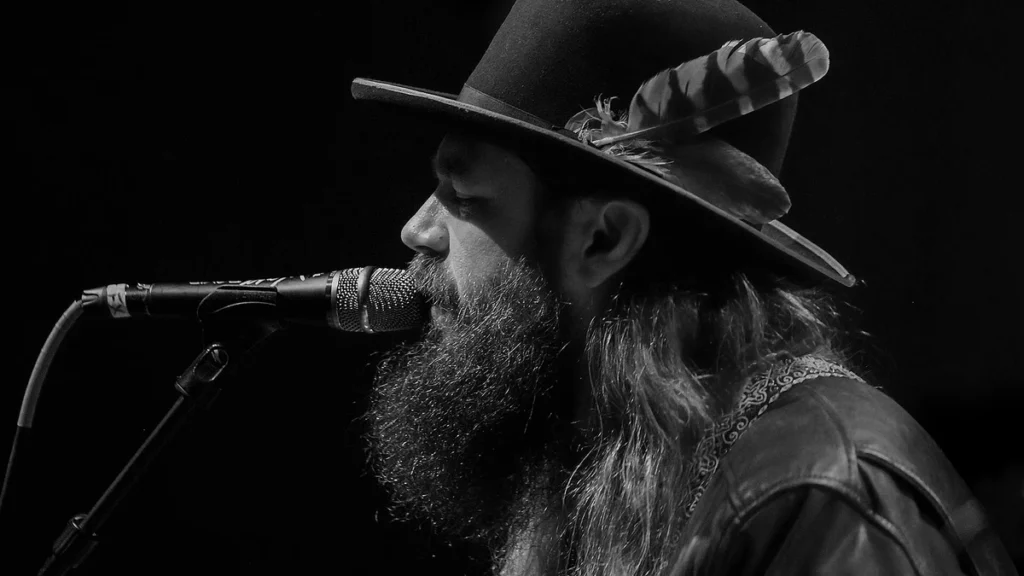
Ward Davis performing.
Ward Davis performing.
The most personal record Ward Davis has made ends its argument with a song he did not write. Here I Am, released on 13 February through MNRK Records, takes its title from a track by another writer, and includes a Harley Allen song besides. On an album assembled out of a divorce, that is a strange and telling decision.
Davis put the project in one sentence when it came out. “I’ve made more bad choices in my life than I can count,” he told Nashville.com. “But when I listen back to this record, I hear the truth.” Truth, on the evidence of the track list, was not required to be autobiographical in origin.
Eleven Songs From Three Subjects
The album draws on faith, sobriety and the end of a marriage, and it does not separate them into sections. “Downright Awful Stupid Beautiful Lie” opens on self-deception. “To Tear Myself Apart” is the harshest self-assessment here, carried by Dan Dugmore’s lap steel. “I Need To Be Still” sits near the centre of the sequence and names the problem the rest of the record circles.
Trigger’s Saving Country Music review, which scored it 8.2 out of 10, makes the useful observation that some of these songs have existed for years and others are recent, yet the album still reads as one statement. That is a sequencing achievement rather than a writing one.
It is also the reason the borrowed songs work. If the organising principle is a subject rather than a period of composition, then authorship becomes secondary to fit. A song written by Harley Allen about strays can carry the same argument as one Davis wrote about himself.
The three subjects are more entangled than a track list can show. Sobriety and divorce tend to arrive in the same period of a life and each is routinely blamed for the other; faith turns up because it is what people reach for when the first two have removed the alternatives. Writing them as separate topics would have been tidier and false.
What the record avoids, notably, is the redemption arc. There is no song where the drinking stops and the marriage is saved, because that is not what happened. The sequence moves from self-deception through self-assessment to a closing position that is stable rather than happy.
A Session Band With Fifty Years of Nashville in It
Jim “Moose” Brown produced and played keyboards. The band around him is close to a definition of the Nashville A-team: Eddie Bayers on drums, Brent Mason and Josh Brown on guitars, Allison Prestwood on bass, Dan Dugmore on lap steel. Chris Utley mixed.
Hiring players of that standing for a record about personal collapse is a deliberate contrast. These are musicians whose entire discipline is restraint and precision, and putting them behind material this raw prevents the performance from becoming an event in itself. The songs stay the subject.
There is a cost to the approach, and Trigger’s review gestures at it. A band this fluent can make anything sound finished, including a song that has not fully earned it, which is part of why “Hurt You” stands out as thin — the arrangement gives it a confidence the writing does not support.
Dugmore’s lap steel is the exception that proves the method works. Steel is the instrument most capable of overplaying a sad country song, and on “To Tear Myself Apart” it stays underneath the vocal, commenting rather than competing. That is a session player’s judgment, not a producer’s instruction.
The album credits show how compact the result is: eleven tracks, none longer than four minutes and six seconds. A record about divorce and faith could easily have sprawled. This one is disciplined to the point of brevity.
The Songs About the Marriage
“Found” is the clearest divorce song on the record, and Trigger rates it a close second to Davis’s 2023 EP Sunday Morning for that subject. It had already been recorded by Cody Jinks, which makes Davis’s version a reclaiming rather than a debut.
“Hurt You” has a similar history: Davis co-wrote it with Jinks and it first appeared on Jinks’s 2021 album Mercy. Trigger is unconvinced by it, calling it shallow and wondering aloud whether the shallowness is the point. That is a fair reading of a song whose title states its whole content.
“Somewhere Lonely” leans contemporary, and “Nothing On You” is a traditional country duet with Julianna Rankin that opens on a double chuck fiddle figure. The closer, “Wouldn’t Wanna Be Me Right Now”, was the track reviewers and commenters returned to most, and it is the one that states the record’s position without any consolation attached.
Why the Covers Are the Argument
Two songs on Here I Am come from other pens, including the title track, and Trigger notes both were selected to complete the album’s thematic arc. That is an unusual admission for a writer of Davis’s standing, whose songs have been cut by Willie Nelson and Cody Jinks and used in Yellowstone and Landman.
It is also the most honest thing on the record. A person coming out of a divorce and into sobriety does not usually arrive with a complete account of themselves; the gaps get filled by things other people said better. Choosing two outside songs to finish the sequence enacts that rather than describing it.
The alternative — writing two more songs to cover the same ground — would have produced a more conventional singer-songwriter album and a less truthful one. Davis appears to have understood the trade and taken the less flattering option.
What “Stray Dogs and Alley Cats” Is Doing Here
Harley Allen, who wrote it, was a bluegrass singer and a songwriter’s songwriter — a man whose material was cut widely while his own name stayed largely inside the trade. Choosing one of his songs for an album about being overlooked by your own life has a second layer to it that Davis is unlikely to have missed.
The song’s subject helps too. Strays are the standard country image for people who have run out of places to be, and on a record made after a marriage ended and the drinking stopped, that is not a metaphor requiring much decoding.
Placed at track ten, immediately before the closer, it functions as the album’s last piece of evidence before the verdict. That is careful sequencing, and it is the strongest argument that the borrowed songs were chosen rather than merely available.
An Opry Debut, Twenty Years In
Davis made his Grand Ole Opry debut on 13 March, a month after the album appeared. For a writer whose songs have been recorded by some of the format’s largest names for well over a decade, arriving at that stage only now says something about how country music distinguishes between writers and artists.
The distinction is not merely ceremonial. A songwriter earns from cuts and publishing; an artist earns from tickets and records, and needs a public identity to do it. Davis has spent most of his career on the first side of that line, and Here I Am is the record that most clearly belongs to the second.
That trajectory is common in this part of the format. Cory Branan spent twenty years being praised and under-heard in much the same way. What changes it, when anything does, is a record specific enough that the audience stops hearing a professional and starts hearing a person.
About The Author

 Why the Glockenspiel Survived: Bed by Stacy Henle and the Craft of a Quiet Folk Single
  Maybe Magic by Ryan Sweezey and a Decade of Unfinished Songs: The Long Version
  Where Deep Blue Sea Came From: Kadi Beth and a Mayday Call Over Dark Water
  Backyard Getaway by Emily Fraser, a Pop-Country Escape: The Long Version
  Why New Orleans Blues Rock Survived the Move to Switzerland on Rising by Jeb Rault
  Where I Asked Jesus & He Said No Came From: The Martha Groves Perry and Pat Thrall Protest Single