
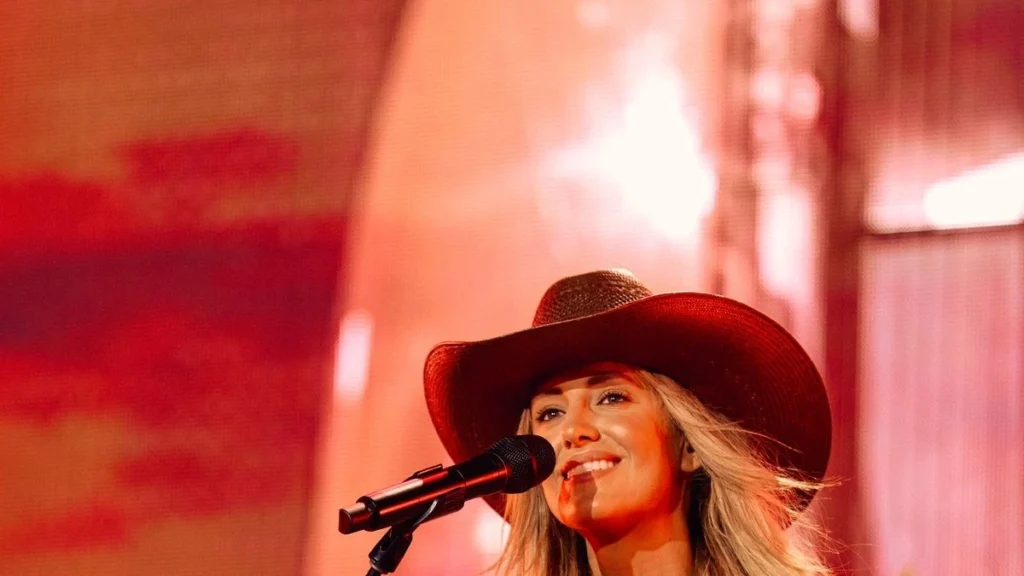
Lainey Wilson performing in 2024.
Lainey Wilson performing in 2024.
The songwriting credit on Lainey Wilson’s ninth number one reads: Lainey Wilson, Andy Albert, Trannie Anderson, Dallas Wilson, Harold Arlen, Yip Harburg. Four of those people worked on it. The other two wrote “Over the Rainbow” for a 1939 film and have been dead for decades.
“Somewhere Over Laredo” topped country radio in January, and it got there interpolating the most famous song in the American songbook. That is a pop mechanic arriving at country radio with the paperwork done properly.
What Interpolation Actually Costs
A sample is a recording; an interpolation is the melody, re-performed. Using one means the original writers join your credit permanently, sharing in every stream and every radio spin for as long as the copyright runs. Arlen and Harburg’s estates now hold a piece of a country number one.
Hip-hop and pop have worked this way for thirty years, which is why chart-topping singles routinely carry six or eight names. Country has been slower to it, partly because the format’s self-image runs on original writing and a three-writer room. A six-name credit still reads as unusual on a country chart.
The trade is straightforward. Wilson gives up a share of a song and receives, in exchange, a melody every listener already knows before the first chorus arrives. On a format where familiarity drives radio adds, that is not a small thing.
There is a craft cost as well as a financial one. A borrowed melody arrives with its own emotional instructions already written, and the new lyric has to either agree with them or work against them deliberately. Most interpolations fail by simply riding the original’s feeling and hoping nobody notices the new song underneath is thin.
What keeps this one honest is that the borrowing is announced in the title. “Somewhere Over Laredo” tells a listener exactly what it is doing before a note plays, which converts the interpolation from a hidden shortcut into the premise of the song. That is a harder thing to write and an easier thing to defend.
A Grill, a Queue at Universal, and a Vinyl Chair
The origin story, as Wilson told Country Now, is unglamorous in the way most good ones are. Andy Albert had the idea while grilling, thinking about “Somewhere Over the Rainbow”. He and Trannie Anderson worked on it standing in line at Universal Studios in Orlando.
Anderson brought it to Wilson in Montana. “I knew when what they had started on sounded that good, just by tapping on the side of a vinyl chair, that we had something,” Wilson said.
That detail is the one worth keeping. A song carrying an eighty-seven-year-old melody and a six-way split was judged, at the moment of decision, by whether it held up with somebody drumming on furniture. The infrastructure came later.
The Numbers It Put Up
The single went to country radio on 27 May 2025 as the third from Whirlwind and was the most added song at the format that week. It drew more than 1.16 million streams across platforms in its first twenty-four hours, the biggest streaming debut of Wilson’s career.
It then took roughly eight months to reach No. 1, which is ordinary for country radio and glacial by any other format’s standards. The gap between a record streaming debut and a January chart-topper is the clearest illustration available of how differently the two systems move.
Two of Wilson’s three 2026 Grammy nominations are for this song, in Best Country Solo Performance and Best Country Song. The second of those is a songwriting award, which means the nomination technically extends to Arlen and Harburg.
A songwriting nomination shared with two men who died before the nominee was born is a genuine oddity, and it is a direct consequence of doing the borrowing honestly. A cleared interpolation puts the estates on the ballot; an uncleared one puts everyone in court.
The eight-month climb also explains why the deluxe edition was worth making at all. A single that needs most of a year to peak cannot be attached to an album already twelve months old at the point of release, unless the label gives that album a second launch — which is precisely what the reissue did.
The Deluxe Edition as a Second Album Cycle
“Somewhere Over Laredo” was not on Whirlwind when it came out. The album arrived on 23 August 2024 through BBR Music Group, produced by Jay Joyce, fourteen tracks, entering at No. 8 on the Billboard 200 and No. 3 on Top Country Albums with 48,000 equivalent units.
The deluxe edition followed on 22 August 2025 — a year later almost to the day — adding five songs: “Somewhere Over Laredo”, “King Ranch, King George, King James”, “Yesterday, All Day, Every Day”, “Bell Bottoms Up” and “Peace, Love and Cowboys”.
The deluxe reissue has become country’s standard method of extending an album cycle to two years, and this is the case that justifies it. The biggest single of the campaign was not on the record when the campaign started. Radio treats a deluxe track as new; streaming treats it as catalogue depth; the artist gets another year before needing a new album.
It is a different solution to the same problem Luke Bryan is managing with a ninth studio album — how to keep a radio-dependent career supplied with singles — and it costs considerably less.
What She Is Doing While the Album Waits
Wilson has confirmed new music is coming without committing to when. “We’re already cooking some stuff up,” she told Country Now. “To tell you the truth, we were already in the kitchen cooking it up before Whirlwind was even out.” She has been working on it, she says, for more than a year and a half.
In the meantime the release schedule is filled by everything except a studio album. MusicRow reported a live EP, Lainey Wilson (Amazon Music presents: Live from Stagecoach 2026), out on 1 May with six songs: “Can’t Sit Still”, “Wildflowers and Wild Horses”, “Good Horses”, “Road Runner”, “Things A Man Oughta Know” and “Watermelon Moonshine”.
There is also a Netflix documentary, Lainey Wilson: Keepin’ Country Cool, an acting debut in Universal’s adaptation of Reminders of Him, seven ACM nominations, a headline run in New Zealand and Australia, RODEOHOUSTON, and select dates on Chris Stapleton’s All-American Road Show.
Why This Counts as Country Pop
The genre label is doing real work here rather than serving as an insult. Country pop, as a category, describes country records built with pop’s compositional tools, and interpolation is among the most characteristic of those tools. A song that borrows a melody the whole audience can already hum is operating on pop logic regardless of the fiddle on it.
Wilson’s own position is that the two things are not in tension. “I feel like I’m also right where I’m supposed to be and feeling more creative than ever,” she said. “And it’s good. 2026 is going to be an exciting year.”
The song she chose for the borrowing supports her. “Over the Rainbow” is not a pop song in any modern sense; it is a 1939 film ballad, and the country audience’s relationship with it runs through decades of Sunday afternoon television rather than through radio. Laredo is a border city in Texas. The joke in the title is that the two halves belong to entirely different Americas, and the record’s argument is that they do not.
“The more experience I have, the more I realize that I’ve got more to say and share and it’s going to be good,” Wilson said of the album still in progress. On the evidence of a number one built out of a 1939 melody and a conversation in a theme-park queue, the method is working.
About The Author

 Why the Glockenspiel Survived: Bed by Stacy Henle and the Craft of a Quiet Folk Single
  Maybe Magic by Ryan Sweezey and a Decade of Unfinished Songs: The Long Version
  Where Deep Blue Sea Came From: Kadi Beth and a Mayday Call Over Dark Water
  Backyard Getaway by Emily Fraser, a Pop-Country Escape: The Long Version
  Why New Orleans Blues Rock Survived the Move to Switzerland on Rising by Jeb Rault
  Where I Asked Jesus & He Said No Came From: The Martha Groves Perry and Pat Thrall Protest Single