
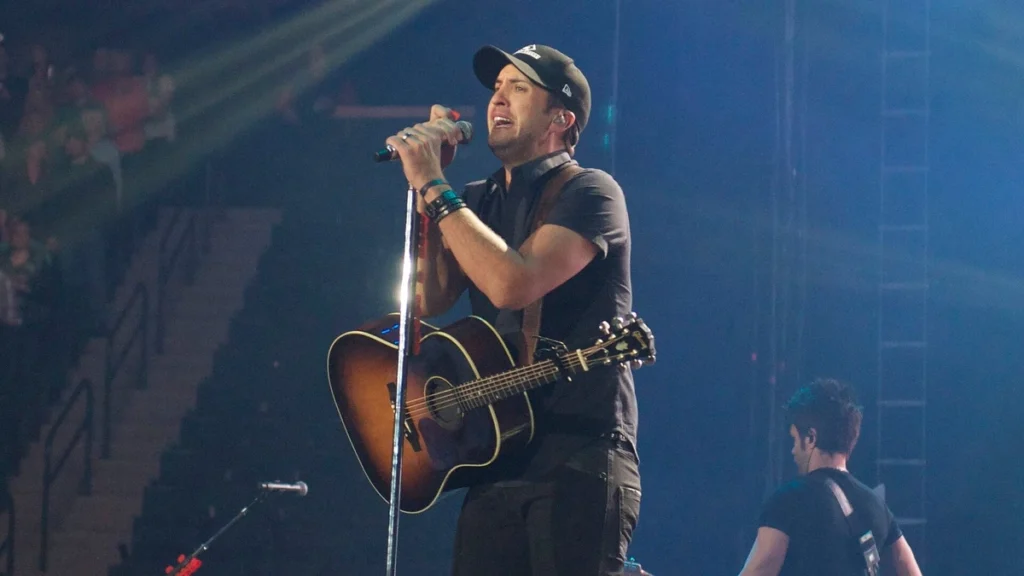
Luke Bryan performing.
Luke Bryan performing.
Track five on Luke Bryan’s ninth album is called “Fish Hunt Golf Drink”. It is difficult to think of four words that more efficiently describe the subgenre he helped build, and the fact that he is still writing them in 2026 is the most interesting thing about Signs.
The record arrives on 18 September through MCA Nashville. MusicRow reported the announcement, made on American Idol on 11 May after Bryan wrapped his ninth season as a judge, with Jeff Stevens and Jody Stevens producing.
Luke Combs Opens the Album
The first track is “Finders Keepers”, a duet with Luke Combs, and it is the biggest thing on the record by commercial logic alone. Holler notes the pairing reached the public through pre-order listings and Genius before anyone announced it.
The two have circled each other for years. Combs has named Bryan an early influence, they appeared together at the 2018 CMA Awards, and Bryan co-wrote “Little Country Boys” on Combs’s 2024 album Fathers & Sons. A duet was overdue rather than surprising.
Putting it at track one is the notable decision. A guest of Combs’s current standing would normally be held back to mid-album as a mid-cycle single. Leading with it says the record is being sold on that collaboration, and that Bryan is comfortable sharing his own opening slot.
The Full Twelve
The running order is “Finders Keepers”, “Country and She Knows It”, “Word on the Street”, “Signs”, “Fish Hunt Golf Drink”, “Made It a Memory”, “Woods”, “Down Goes the Whiskey”, “Crooked Rows of Corn”, “I Liked Loving You”, “Killer” and “Praying by the Rules”.
Four of those were out before the album: “Country and She Knows It” went to country radio on 30 March, followed by “Word on the Street”, the title track on 7 August and “Made It a Memory”. A third of the record was public before release day, which is now standard practice for an artist at this level.
The titles themselves map the territory precisely — whiskey, woods, corn rows, fishing, hunting, golf. This is not a writer reaching for new subject matter. It is a writer working a vocabulary he established more than a decade ago, and doing it without apology.
A Website That Leaked the Record
Bryan promoted the album through theresgonnabesigns.com, telling fans to keep an eye on it and to let him know what they found. It was a scavenger-hunt campaign, and it worked in the way these campaigns usually work, which is to say imperfectly.
The Combs collaboration surfaced through retail pre-order metadata rather than through the site. That is now the standard leak vector: distribution systems publish track credits days before a marketing team is ready, and the news breaks itself.
Bryan’s own framing of the album is unpretentious. “I’ve been working on this album for the past year, and I just love how it turned out,” he told MusicRow, adding that his fans have always let him record songs that make you feel good, so he went in wanting everyone to have fun.
Two Songs That Tell One Story
The sequencing hides a small piece of craft. “Word on the Street” sits at track three and deals with hearing rumours that an ex has moved on; the title track follows it at four, and its narrator has done the moving on himself. Holler’s reading of the lyric describes a man who will not announce the split or speak badly of anyone, but who trusts the evidence to speak — a new Chevrolet, new boots, a Florida tan.
Placing those two consecutively turns a pair of unrelated radio songs into a short narrative. It is a modest trick and it costs nothing, but it is the sort of thing that separates a sequenced album from a playlist of singles.
The production on “Signs” is also not what the track list implies. Holler describes disco-inspired, pop-infused textures with cushioning synths and sleek harmonies — closer to the pop end of country radio than to anything a title like “Fish Hunt Golf Drink” would suggest. It was written by J Mills, Jody Stevens, Patrick Murphy, Tommy Cecil and Jason Duke, with Jeff Stevens producing.
What Bro-Country Became
The label attached itself to Bryan’s generation around 2013 and was rarely meant kindly. It described a wave of mainstream country built on trucks, beer, summer nights and a particular way of addressing women, and it prompted a sustained critical backlash that most of its practitioners have since moved away from.
Bryan mostly has not, and there is an argument for that consistency. An artist who chases each shift in critical fashion ends up with a catalogue that pleases nobody, while one who keeps making the record his audience wants retains the audience. Five Entertainer of the Year wins suggest the second strategy has not hurt him.
What has changed is the surrounding weather. The commercial centre of country has moved towards the rougher, more traditional sound of writers like Ashley McBryde and towards streaming-native artists, leaving the mid-2010s radio style holding a smaller share of a much larger format.
The Songs That Are Not Jokes
It would be easy to read the track list as twelve variations on one idea, and the sequencing works against that. “I Liked Loving You” and “Praying by the Rules” sit at positions ten and twelve, which is where albums of this kind put the material that is meant to be taken seriously.
Bryan has lost a brother and a sister, and has spoken publicly about both. That history sits underneath a catalogue otherwise built on good times, and it is the reason his ballads land differently from those of peers whose sad songs are purely constructed.
Whether Signs uses that is the open question the track list cannot answer. Four songs are known; eight are not, and the reviews will not exist until after 18 September.
The signals available are mixed. A record whose known singles include a disco-textured breakup song and a list of leisure activities is not obviously reaching for depth, but the two slots country albums traditionally reserve for it are occupied by titles — “I Liked Loving You”, “Praying by the Rules” — that at least gesture at something other than a good time.
Why the Album Still Matters Commercially
Bryan remains one of the few country artists who can headline stadiums, and the album is supported by a Farm Tour run in the autumn and a Bridgestone Arena date in September. The record is the reason for the touring rather than the product being sold.
That inversion is now universal in country music, but it changes what an album like this is for. Signs does not need to break a new artist or shift a genre. It needs to give a large existing audience twelve reasons to buy a ticket, and on the evidence of the titles, it is engineered precisely for that.
There is also a structural reason a major-label country album still exists at all in 2026. Radio remains the format’s gatekeeper in a way it is for no other genre, and radio programmes singles from albums rather than from loose releases. Bryan needs the object even if his audience mostly hears four songs from it.
The tracklist landed on 28 August, three weeks before release. Everything else is now a matter of waiting.
About The Author

 Miko Marks Opens Hell Or High Water at the Little Bighorn
  Hot Club of Cowtown Answered a Village Voice Ad and Stayed Thirty Years
  Marty Stuart Made a Surf Guitar Album on Clarence White’s Telecaster
  Turnpike Troubadours Covered Robert Earl Keen With Sierra Hull
  Jontavious Willis Shares a Ballot With John Primer and Jimmie Vaughan
  Jason Isbell Made an Album Alone With a 1940 Martin in Five Days