
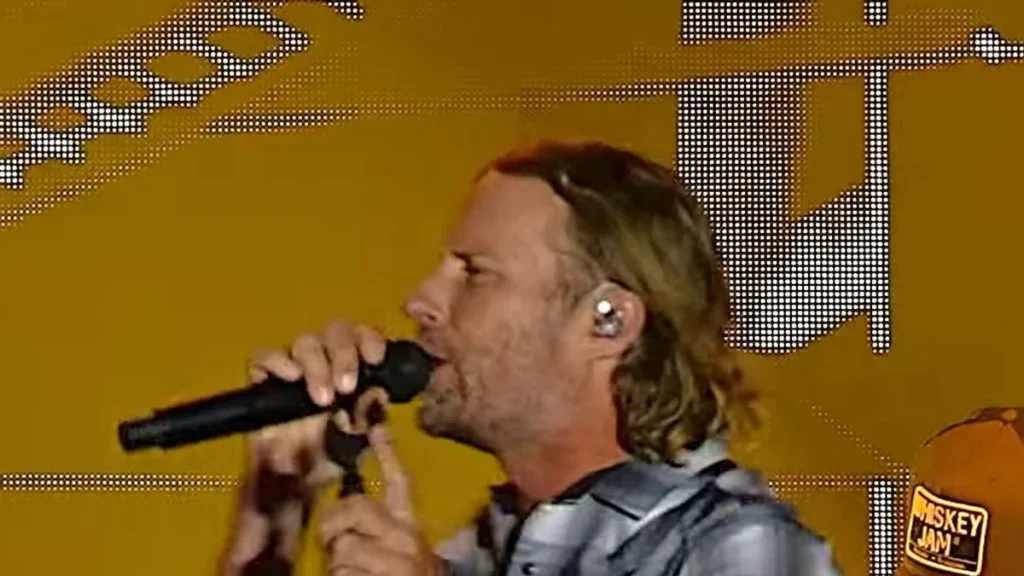
Dierks Bentley performing in 2024.
Dierks Bentley performing in 2024.
Look down the writing credits on Broken Branches and Dierks Bentley’s name appears four times across eleven songs. On the other seven he is a singer and nothing else, which for an artist twenty years into a career is a deliberate act of stepping back.
The album arrived on 13 June 2025 through Capitol Records Nashville, produced by Jon Randall and Ross Copperman with Mary Hilliard Harrington as executive producer. It is his eleventh, and the credits make it the least writerly of them.
Four Credits Out of Eleven
He is on “Cold Beer Can” with Jon Randall, Luke Dick and Stephen Wilson Jr.; on “She Hates Me” in a six-name credit; on “Something Worth Fixing” with Wilson Jr. and Dick; and on the closer, “Don’t Cry for Me”, with Jim Beavers. That is the extent of it.
The other seven belong to writers who are not in the room when the album is discussed. “Jesus Loves Me” is Adam James, Ben Stennis and Allison Veltz Cruz. “Standing in the Sun” is Kyle Sturrock alone. “Off the Map” is Jeremy Bussey, Lauren McLamb and Adam Wood. “For as Long as I Can Remember” is Devin Dawson and Connie Harrington.
Getting to that list took work. Barn Burner describes a months-long process in which Bentley narrowed down a large body of songs before recording anything. Choosing well from thousands is a different skill from writing well, and the album is an argument that it is the rarer one.
The distribution is worth noting too. Three of his four credits sit in the first four tracks, and the fourth is the closer. Whatever he wrote is used to open and to end, and the middle of the record is given over entirely to other people — a structure that reads as an artist framing someone else’s work rather than hiding inside it.
Two names recur on his side of the ledger. Luke Dick and Stephen Wilson Jr. are on two of the four apiece, which means Bentley’s own writing on this album happened almost entirely with the same two collaborators. That is a small room by Nashville standards, where a hit credit routinely runs to five or six.
The Song He Could Not Have Written
“Standing in the Sun” is the clearest case. Kyle Sturrock wrote it by himself, and Bentley’s account of hearing it is unusually candid about his own limits.
“This is one of those songs that I never in a million years could have written on my own, but I’m so glad someone in this town did,” he told uDiscover Music. “Love is such a classic theme in country music, but Kyle was able to write it in a way that is so personal to me… it’s the way I feel it.”
That last clause is the whole justification for a singer’s album. The song is not his, and the feeling is. He described the arrangement as building to feel like a sunrise, and the video was shot in a single take at dawn on his farm outside Nashville — a production choice that only works because the song already had that shape.
What the Title Is For
Bentley’s explanation of the phrase is more expansive than the record needs it to be, and better for it. “The country music community has a lot of broken branches in it. That’s why we’re all here,” he said. “We want to do something a little bit different, and I think everyone sees themselves like that — certainly in country.”
“This is the people’s music and it represents that spirit of individuality so well,” he continued. “It’s just about doing it our own way.”
He extends the idea to how the record was made. “I think that’s what’s special about country — we’re still making music in the studio with our buddies. We’re still getting together and talking about the songs and letting the musicians have a big say. It’s a good team — maybe a little messed up — but that’s the whole idea behind broken branches, so it just works.”
Three Generations on the Title Track
“Broken Branches” itself features John Anderson, a Country Music Hall of Famer, and Riley Green, a generation younger than either of them. Putting all three on one song makes the title do double duty: outsiders, and also a family tree.
The writers are Zach Abend, Beau Bailey and Graham Barham — none of them the artists singing it. A song about a lineage, performed by three generations of singers, written by three people outside the frame entirely, is a fair summary of how Nashville actually works.
Anderson’s presence is the pointed one. His voice belongs to a period of country that the format spent the 2010s moving away from, and hearing it on a current major-label single is a small act of restoration rather than nostalgia.
It is also the kind of booking that only works when the host is not competing. A three-voice track needs someone willing to take the smallest part on his own song, and Bentley has arranged the whole album on that principle — the writers, the guests and the producers all given room he could have kept.
The Rest of the Guest List
Miranda Lambert sings on “Never You”, written by Scooter Carusoe, Ross Copperman and Ben Williams. Stephen Wilson Jr. is on “Cold Beer Can” and co-wrote two of the four songs Bentley did put his name to, which makes him the album’s most consistent collaborator.
Four features across eleven songs is a lot, and on most records it would read as chart insurance. Here the guests are distributed across the album’s range rather than clustered on the singles, which suggests they were chosen for the songs rather than the campaign.
The touring has been the constant. The Broken Branches Tour opened on 29 May 2025 at the Moody Center in Austin, a thirty-city run with Zach Top and The Band Loula opening, and it has carried into 2026. Top is one of the more traditional voices to break through recently, which fits the record he was hired to precede.
What a Curator’s Album Costs
The trade Bentley made is real. A songwriter earns from the publishing on every play; a singer who records outside material does not. Handing seven songs to other writers is a decision with a permanent cost attached, and he made it on his eleventh album rather than his first, when it would have been ordinary.
It also cuts against the era he came up in. The bro-country years rewarded artists who put their names on everything, and the co-write became so standard that a six-name credit stopped meaning anything. An album that separates the writing from the singing is unusual now precisely because the two were fused for a decade.
The alternative is still visible across the format. Luke Bryan’s ninth album takes the opposite route, leaning on Nashville writers for most of the record while keeping the persona entirely intact — a curator’s method used to protect a brand rather than to escape one.
What Bentley gets in exchange is a record that does not sound like a man repeating himself. “Jesus Loves Me”, “Well Well Whiskey”, “Off the Map” and “For as Long as I Can Remember” have nothing in common except that he chose them, and eleven albums in, that is a more interesting organising principle than a house style.
Whether it works is a matter for the listener rather than the credits. But the eleven songs on Broken Branches are the eleven he wanted out of everything Nashville had, and there are worse things for an established artist to be than a good judge of other people’s writing.
About The Author

 Maybe Magic by Ryan Sweezey and a Decade of Unfinished Songs: The Long Version
  Where Deep Blue Sea Came From: Kadi Beth and a Mayday Call Over Dark Water
  Backyard Getaway by Emily Fraser, a Pop-Country Escape: The Long Version
  Why New Orleans Blues Rock Survived the Move to Switzerland on Rising by Jeb Rault
  Where I Asked Jesus & He Said No Came From: The Martha Groves Perry and Pat Thrall Protest Single
  Brandi Carlile’s Ted Lasso Theme Is the First Sung by a Woman