
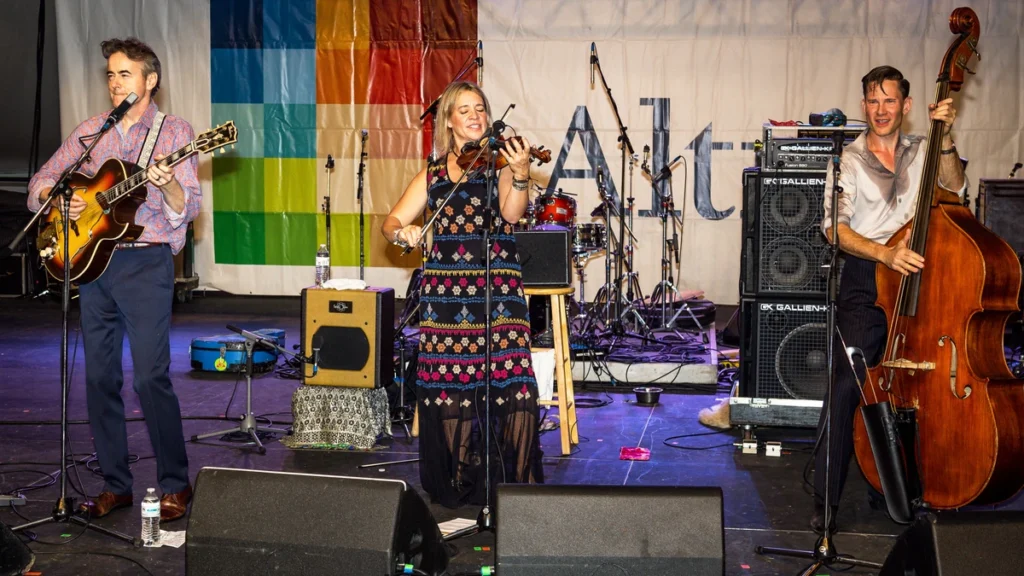
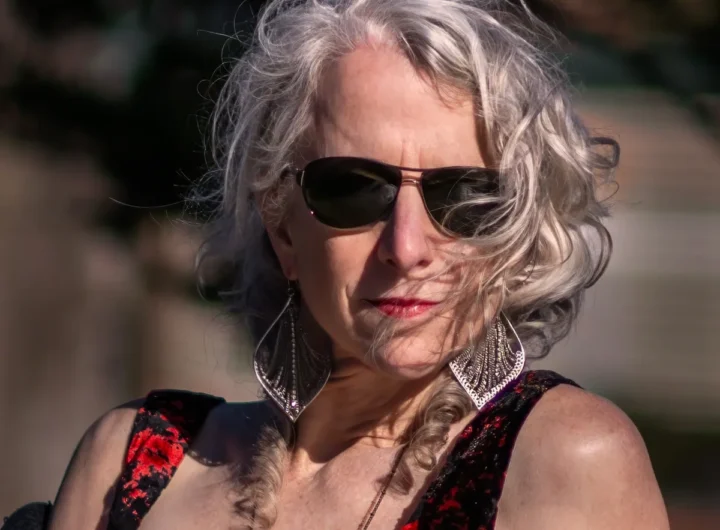
Hot Club of Cowtown performing at the RVA Folk Festival.
Hot Club of Cowtown performing at the RVA Folk Festival.
In 1994 Elana James put a classified ad in the Village Voice looking for musicians. Whit Smith answered it. Thirty-plus years, fourteen records and a State Department passport later, they are still playing together.
Their newest album, Limelight, came out on 17 June 2025. The band’s own description of it is the best summary available: “eclectic standards, cowboy tunes, hot jazz, a Roma folk song and a waltz for Lupa!”
From a Classified Ad to Austin
The pair performed first as Whit & Elana in New York and had become Hot Club of Cowtown by 1997, at which point they relocated to Austin. The line-up settled in 2001 when the bassist Jake Erwin joined, and it has not changed since.
The name is a joke that also happens to be a thesis. The Quintette du Hot Club de France was Django Reinhardt’s group; Cowtown is Fort Worth. Putting the two together names exactly the crossing this band works — Parisian gypsy jazz and Texas dance-hall swing, which turn out to share a great deal once you take the drums away.
That crossing is not a novelty. Western swing was always a jazz music played by country musicians, and Bob Wills’s bands were improvising over standards in the same decade Reinhardt was. The two traditions were contemporaries who mostly did not meet, and this trio has spent thirty years introducing them.
Eleven Songs and a Waltz for Lupa
Limelight draws its material from Jimmie Rodgers, Marty Robbins, Joe Venuti, Bob Wills and Django Reinhardt — a list that sets out the band’s whole territory in five names. Rodgers and Robbins are the country lineage, Wills the swing, Venuti and Reinhardt the jazz violin and guitar tradition the group is built on.
Joe Venuti’s inclusion is the connoisseur’s choice. He is the founding figure of jazz violin, and a fiddle-led band that reaches for him rather than for a country fiddle standard is announcing which of its two halves is driving.
The waltz “for Lupa” is the album’s one unexplained detail, and it is a reminder of what a small independent record can do that a label release cannot. Nobody signs off on a dedication like that; it exists because three people wanted it there.
A Roma folk song on the same record is the other tell. It is the actual source material of the music Reinhardt made, reached for directly rather than through the jazz that came out of it, and a band willing to go that far upstream is not simply playing a style — it is tracing where the style came from.
Eleven tracks is also the same length as their album of originals, which suggests a settled idea of what a Hot Club of Cowtown record is. Whatever the material, the shape stays the same: about forty minutes, no filler, and a sequence that moves between the country songs and the jazz ones rather than grouping them.
Three Instruments and No Drums
The band is fiddle, guitar and upright bass. That is the Reinhardt configuration rather than the western swing one — Wills carried steel, horns and a rhythm section — and it means every beat on the record comes from Erwin’s bass and Smith’s right hand.
It is also why they can play a room of any size. A trio with no amplification requirement and no drum kit is bookable at a folk festival, a jazz series and a dance hall without changing anything, which is precisely the range their touring history shows.
Their earlier records sort the repertoire deliberately. What Makes Bob Holler (2011) is western swing standards; Rendezvous in Rhythm (2013) is the Django material; Midnight on the Trail (2016) is cowboy ballads. Rather than blend the influences into a house style, they have periodically separated them and let each stand alone.
The 2019 EP Crossing the Great Divide goes somewhere else again, taking songs by Robbie Robertson, Bob Dylan and The Band. That is a fourth tradition entirely, and it demonstrates the argument the instrumentation makes: give this trio any American song and the arrangement writes itself.
Fourteen releases since 1998 is also a working rate rather than a career plan. A band that tours as constantly as this one and still puts out a record every two or three years is running on the older model, where the album documents what the group currently sounds like rather than launching a campaign.
The Album of Originals
Wild Kingdom, released in 2019 on Gold Strike Records, contains more of the band’s own writing than anything else they have made. Smith was blunt with the Houston Press about what the originals were for: “They’re not antique! It’s not political, but it’s not moon, spoon, and June either.”
The division of labour is instructive. James’s songs — “My Candy”, “Near Mrs.”, “Rodeo Blues”, “Last Call” — lean towards western swing and romance. Smith’s, including “Caveman”, “Ways of Escape” and “Billy the Kid”, have what the paper called a more quirky, psychological quality, with prehistoric and time-travelling themes.
They brought in help for it too: Damien Llanes on drums, Joe Kerr on piano and Oliver Rajamani on tabla and percussion. A tabla on a western swing record is either a mistake or a band that has stopped worrying about the label, and thirty years in it is clearly the latter.
Musical Ambassadors, Officially
The touring list is the most improbable thing about them. They have opened for Bob Dylan and Willie Nelson, played with Bryan Ferry and Roxy Music, appeared with the Avett Brothers, Dan Hicks, the Mavericks and the Squirrel Nut Zippers.
The venues run just as wide: Jazz at Lincoln Center’s Women in Jazz series, Glastonbury, Fuji Rock in Japan, Byron Bay in Australia, Stagecoach, and the grand opening of the Country Music Hall of Fame. They have also served as US State Department musical ambassadors to Azerbaijan, Armenia, Algeria, Georgia and Oman.
The critics have generally landed in the same place. The New York Times called them “an arsenal full of technique and joy”; the Belfast Telegraph, “a pretty much perfect country trio at the very top of their game”; the Independent placed them “at that crossroads where country meets jazz and chases the blues away”.
Three Texas Nights in September
The band plays the Continental Club in Austin on 2 September and again on 9 September, with the Cowboy Capital Western Swing Music Festival at the Birdsong Amphitheater in Stephenville, Texas, on the 5th.
A dedicated western swing festival existing in 2026 is itself worth noting. The genre has no radio format and no chart, and it survives on exactly this kind of infrastructure — a festival in a Texas town, a residency at a club that has been booking the music for decades, and a handful of bands willing to keep the instrumentation.
It is the same economy Asleep at the Wheel has worked in for fifty-five years, at a different scale. Ray Benson defines western swing by its instruments rather than its songbook; Hot Club of Cowtown keeps three of those instruments and proves the definition holds even when most of them are missing.
Two Continental Club dates a week apart, with the festival in between, is a booking pattern that only works for a band with a local base. Austin is home, the club is a room they can fill on a Wednesday, and the festival is the reason to be in Texas that week rather than anywhere else on a thirty-year touring circuit.
About The Author

 Why the Glockenspiel Survived: Bed by Stacy Henle and the Craft of a Quiet Folk Single
  Maybe Magic by Ryan Sweezey and a Decade of Unfinished Songs: The Long Version
  Where Deep Blue Sea Came From: Kadi Beth and a Mayday Call Over Dark Water
  Backyard Getaway by Emily Fraser, a Pop-Country Escape: The Long Version
  Why New Orleans Blues Rock Survived the Move to Switzerland on Rising by Jeb Rault
  Where I Asked Jesus & He Said No Came From: The Martha Groves Perry and Pat Thrall Protest Single