
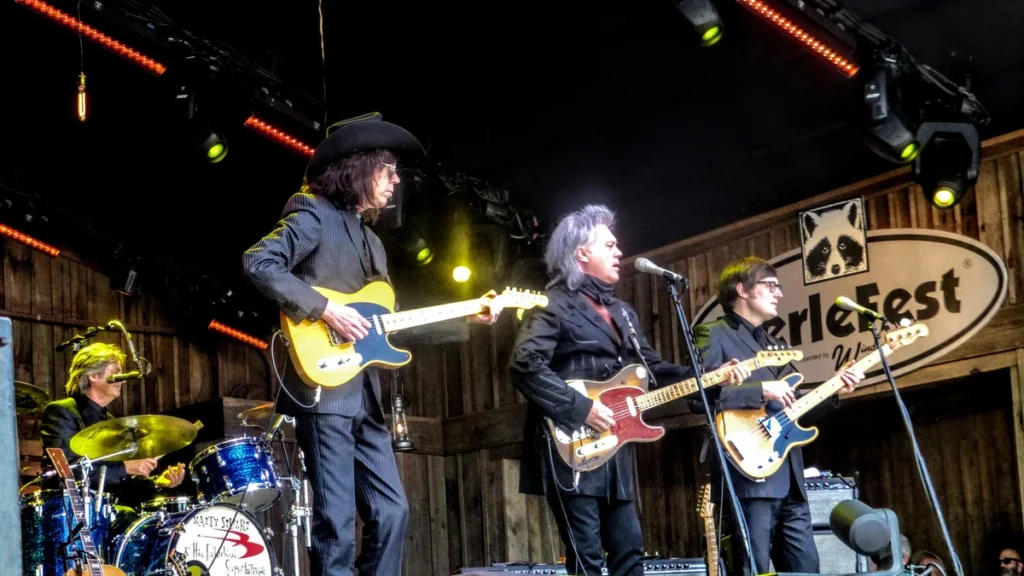
Marty Stuart and His Fabulous Superlatives performing at MerleFest.
Marty Stuart and His Fabulous Superlatives performing at MerleFest.
Fifty years into a career built on traditional country, Marty Stuart made a surf record. Twenty original instrumentals, no vocals anywhere, played largely on a 1954 Telecaster that used to belong to Clarence White.
Space Junk came out on 12 April 2025 as a Record Store Day exclusive through Snakefarm Records — a double LP, 1,700 copies. “Instrumentals have always been a part of the Fabulous Superlatives repertoire,” Stuart said, “but this is the first completely instrumental album we’ve done.”
Twenty Tracks and One Piece of Small Print
The running order is “Graveyard”, “All The Pretty Horses”, “Catalina”, “Over The Moon”, “Slipnote Serenade”, “Space Junk”, “El Zorro”, “Coastline”, “The Ballad of the Lonely Surfer”, “Bat Patrol”, “Till We Meet Again”, “Waiting on Sundown”, “La Tingo Tango”, “Rhapsidio Sangre de Cristo in E Major”, “Showcake”, “Jody the Fly (Romance in Laguna)”, “Malibu Dawn”, “The Surfin’ Cowboy”, “California Pt. 1 (Bobbie Gentry, Please Call Home)” and “Waltz of the Waves”.
Saving Country Music’s review flags a detail worth knowing before the needle drops: the record plays at 45 rpm, and that is noted only in tiny print on the label. A generation raised on 33 has spent this album wondering why country’s most fastidious traditionalist suddenly sounded so slow.
It has since escaped the vinyl-only ghetto — a wider release through Stuart’s website in November 2025, and a CD in January 2026. For an album this specific, the Record Store Day pressing was always going to be the collectors’ object rather than the distribution.
Seventeen hundred copies is a deliberately small number, and it tells you what the record was for. A major-label country artist releasing twenty instrumentals to a limited vinyl run is not chasing anything; the pressing is sized to the people who were always going to want it, and the later formats exist for everyone who found out afterwards.
The double-LP format matters too. Twenty short instrumentals across four sides is a sequencing problem — each side has to work as a complete listening stretch of about ten minutes — and it is the reason the album alternates between the surf material and the slower western pieces rather than grouping them.
The Guitar That Bends
Stuart’s main instrument here is a 1954 Telecaster he calls “Clarence”, formerly owned by Clarence White and fitted with a B-bender — the lever mechanism that pulls the B string up a tone, producing the pedal-steel bends a guitar cannot otherwise make.
That guitar is not a prop. The B-bender is the specific device that let country guitar imitate steel, and an album of instrumentals is the only context where its sound has nowhere to hide behind a vocal. Choosing it for a surf record is a deliberate collision of two traditions that were never in the same room.
The rest of the band is the Fabulous Superlatives: “Cousin” Kenny Vaughan on guitar, “Handsome” Harry Stinson on drums, Chris Scruggs on bass and steel — including Hawaiian steel on the closer, “Waltz of the Waves”. Gary Carter guests on rhythm guitar for “All The Pretty Horses”.
Hawaiian steel is the deep cut in that list. It is the instrument the pedal steel descended from, and reaching past the country version to the original is exactly the kind of move a musician makes when the vocals are gone and there is room to be specific about lineage.
Two guitarists in a band this good is also a structural choice rather than a luxury. Vaughan is a formidable player in his own right, and an instrumental album gives the two of them somewhere to trade that a vocal record, where a guitar has to stay out of a singer’s way, simply does not.
Surf, Morricone and a Bond Theme
Stuart is direct about the sources. The inspiration came from “two of my favorite bands from sixties, The Ventures and Herb Alpert and the Tijuana Brass,” he told Relix.
The review hears more than that: Dick Dale’s reverb-drenched surf, Ennio Morricone’s western scores, John Barry’s Bond themes and Duane Eddy’s baritone twang, delivered through vintage Fenders, tremolo bars and tube amplifiers. It was cut at Capitol Studios in Hollywood and the House of Blues studio in Nashville, engineered by Mick Conley.
Those references are less distant from country than they look. Morricone’s western music was written about the same landscape country music sings about, and the surf guitar tone of the early sixties came out of the same Fender amplifiers Bakersfield was using at exactly the same moment. The album is not a departure so much as a road not taken.
Herb Alpert Painted the Sleeve
The cover is a painting called “Dreamcatcher” by Herb Alpert — the Tijuana Brass trumpeter and co-founder of A&M Records, who has spent his later decades as a visual artist. Naming him as an influence and then commissioning the artwork closes the loop rather neatly.
Stuart’s account of the sessions is the least guarded thing he has said in years. “Space Junk turned us back into kids with our first guitars,” he said. “We thought the world needed a fresh instrumental album by a pretty good band.”
On the location: “The creative atmosphere of California always gives me the feeling that the sky is the limit.” And on the point of it: “I hope Space Junk takes the listeners for a ride. It makes me forget my problems and remember why I play guitar.”
Where the Honky Tonk Went
The Superlatives are, in every other setting, one of the most exacting traditional country bands working — Telecasters, brushes, close harmony, a repertoire that runs back through honky tonk and bluegrass. Removing the vocals does not remove that; it exposes it.
An instrumental album is where a band’s actual playing has to carry everything, and the argument Stuart is making is the same one Ray Benson makes about western swing: the genre is the instrumentation, not the songbook. Give four musicians who know the tradition a set of surf tunes and what comes out is still recognisably theirs.
The track titles hold both worlds without apology. “The Surfin’ Cowboy” is the joke stated outright; “California Pt. 1 (Bobbie Gentry, Please Call Home)” is an address to a country songwriter who vanished; “Waltz of the Waves” puts a country time signature on an ocean.
A Wrist That Needs More Time
The 2026 touring has been reorganised around an injury. “Due to an injury sustained in February, Marty needs a little more time for his wrist to heal,” Hoyt Sherman Place announced, moving its Des Moines date from 26 March to 5 June with all original tickets honoured.
A wrist is the specific injury that matters most to the man who made this particular record. An album built on B-bender pulls, tremolo work and sustained picking is not something a guitarist plays around an injury, and the rescheduling rather than cancelling suggests a recovery with an end date.
Seventeen shows remain on the 2026 calendar. A dollar from every ticket sold goes to Stuart’s Congress of Country Music, his 501(c)3 — which is, in the end, the most consistent thing about him. The surf record and the museum are the same instinct: keep the things that made the music, and let people hear them.
About The Author

 Why the Glockenspiel Survived: Bed by Stacy Henle and the Craft of a Quiet Folk Single
  Maybe Magic by Ryan Sweezey and a Decade of Unfinished Songs: The Long Version
  Where Deep Blue Sea Came From: Kadi Beth and a Mayday Call Over Dark Water
  Backyard Getaway by Emily Fraser, a Pop-Country Escape: The Long Version
  Why New Orleans Blues Rock Survived the Move to Switzerland on Rising by Jeb Rault
  Where I Asked Jesus & He Said No Came From: The Martha Groves Perry and Pat Thrall Protest Single