
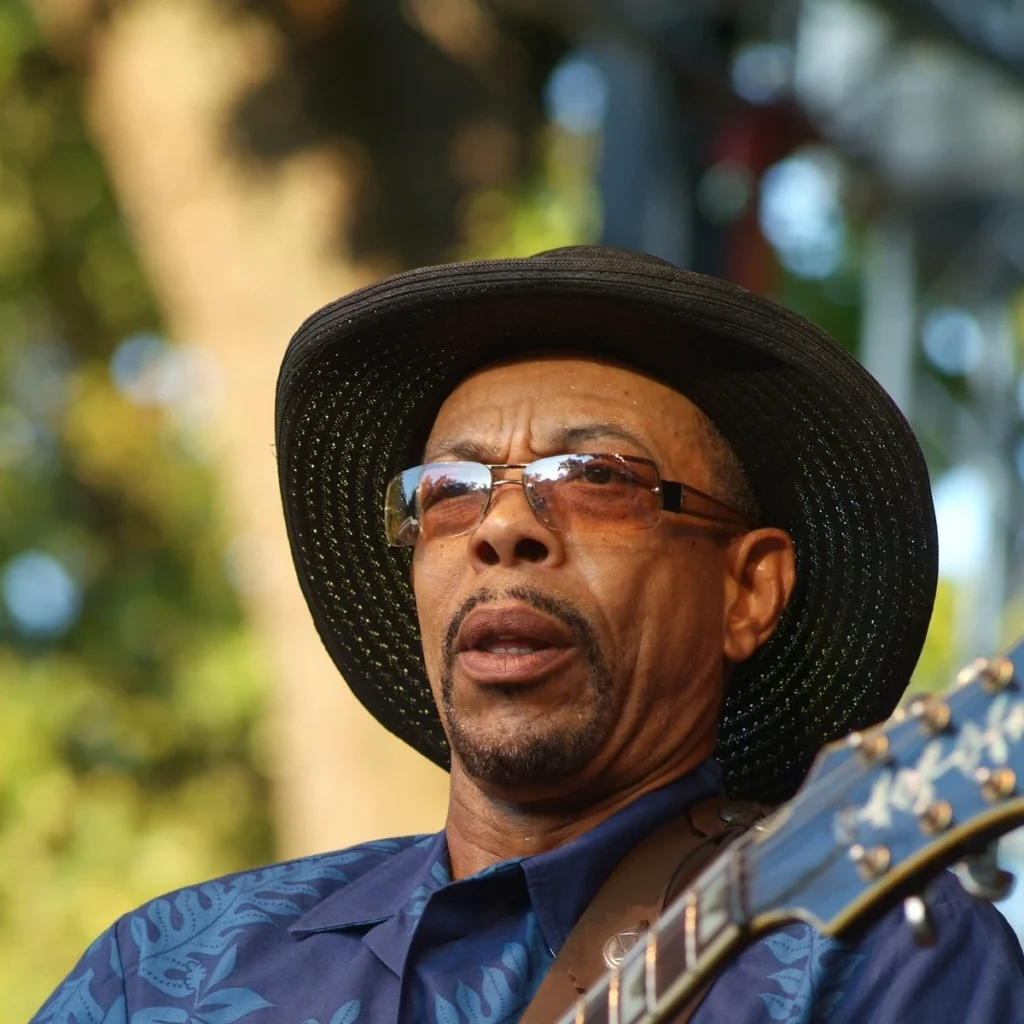
John Primer performing.
John Primer performing.
The Mississippi Blues Trail has approved a historic marker for the birthplace of John Primer in Camden, Mississippi. It is not standing yet, and the reason is money: roughly ten thousand dollars has to be raised before it can go into the ground.
That is an odd sentence to write about a musician who led Muddy Waters’s band, holds three Grammy nominations and a lifetime achievement award, and who took Traditional Blues Male Artist at the Blues Music Awards in Memphis in May. The recognition exists. The plaque is a fundraising problem.
Why the Trail Ran Out of Money
Blues Rock Review’s account sets out the arithmetic. The Trail launched with government funding around 2003, authorised for 120 markers. Roughly 220 now exist, and the original money is gone. New markers are funded by donation through the Mississippi Blues Foundation, with donors able to designate a specific one.
Overshooting an authorised total by nearly a hundred is not a failure of planning so much as a measure of how much history Mississippi actually contains. Every marker commemorates a person, a juke joint, a church or a crossroads that has a legitimate claim, and the list did not stop when the budget did.
The consequence is a queue in which living musicians wait for their own commemoration to be crowdfunded. Primer’s response to it is characteristically unsentimental: he is lucky enough to still be alive, he said, when most of the others are gone, and it means a lot to let people know where he is from and what work he has done.
Camden to Chicago, 1963
Primer was born in Camden in 1945 into a sharecropping family and moved to Chicago in 1963. That journey is the single most important migration in this music, and he made it at eighteen, at close to the last moment when the Chicago blues scene he was joining still had its founders working in it.
What followed is a career spent inside the tradition rather than beside it. He led Muddy Waters’s band for three years, played with Magic Slim and the Teardrops, and now fronts his own Real Deal Blues Band. Each of those is an apprenticeship in the older sense: not a lesson, but a job.
The Chicago Reader’s description of him — that he sustains the living heritage of the blues — is the sort of phrase usually applied to institutions. In this case it names a specific and dwindling function. The players who learned the Chicago sound directly from the men who built it can now be counted, and Primer is one of them.
Going Back to Record
His album Grown in Mississippi answers the marker question from the other direction. Rather than wait for the state to mark where he came from, he went back and recorded there. Chicago Blues Guide documents sessions at Clarksdale Soundstage Studio spread across 2023 and 2024, produced by Michael Frank with Gary Vincent engineering.
His wife and the album’s executive producer, Lisa Becker Primer, described the intention plainly: he wanted to go back to his roots, dig in, and make a record that explored his beginnings. The production followed that logic, using Mississippi musicians and a Mississippi studio rather than importing a Chicago band south.
The guest list reads like a census of who is still working in the region. Bobby Rush appears on “Nothin’ but a Chicken Wing”. Charlie Musselwhite plays harmonica on “Baby Please Don’t Go” and “Shame, Shame, Shame”. Eden Brent, who took the Koko Taylor Award at the same ceremony where Primer won his, plays keyboards on the gospel track “Lay My Burdens Down”.
The Repertoire Tells the Story
The track list moves through the music’s geography. “Meet Me at the Bottom” is a Willie Dixon song, which is Chicago. “Let Me Be Your Electrician” comes from Louisiana Red. “When I Met the Blues” and “Walkin’ Blues” are handled in the Hill Country style, which is northern Mississippi rather than the Delta proper.
Placing those side by side on one album is an argument about how the music actually moved. Chicago blues is Mississippi blues played by people who left, amplified for rooms that needed volume; hearing a Chicago bandleader return and record Hill Country material makes the relationship legible rather than theoretical.
“John’s Blues Holler” opens the record in the oldest form available — the field holler, which predates the twelve-bar structure and the guitar accompaniment both. Starting there and ending on a gospel track with his daughter Aliya singing is a complete map of where this music comes from.
The Sessions Took Two Years
The recording dates are worth stating because they explain the album’s texture. Chicago Blues Guide lists three separate blocks — two in 2023 and one in July 2024 — rather than a single week in a studio. That is how a record gets made when the participants are spread across a region and none of them can stop working.
It also allowed the guest list to accumulate rather than be booked. Assembling Bobby Rush, Charlie Musselwhite, Deak Harp, Lightnin’ Malcolm and Eden Brent in one week would have required a budget nobody in traditional blues has. Across fourteen months, it required patience.
The rhythm section stayed local throughout, with Rickey “Quicksand” Martin and Lee Williams on drums and Harvell Williams Junior on bass. Billy Earheart played piano; Primer’s daughter Aliya sang on the gospel track. It is a family and neighbourhood record in the literal sense, which is the only sense that matters for an album about where somebody is from.
Two Kinds of Recognition
The Blues Foundation’s 2026 winners list put Primer alongside Eden Brent, Kevin Burt and Doug MacLeod — a year in which the older acoustic and traditional idioms took most of the major artist categories.
Awards of that kind are decided by a voting membership and cost nothing to give. A roadside marker requires a specific sum of money, a landowner, a foundry and a maintenance commitment, which is why the two forms of recognition move at such different speeds.
Brent’s win the same night makes the pairing neater still. She grew up in Greenville watching the festival; he grew up in Camden and left. Her Koko Taylor Award honoured someone who stayed close to the source, and his honoured someone who carried it north and kept it intact. Both are Mississippi stories with opposite geography.
There is a practical point buried in the funding shortfall as well. Markers are commissioned while their subjects are alive far less often than the Trail would like, because approval is easier to obtain than money. A plaque unveiled after a musician’s death is a memorial; one unveiled in front of him is a conversation, and considerably more useful to anyone who stops to read it.
Camden is a small place in Madison County, well off the routes tourists take through the Delta. A marker there would not draw crowds, and that is rather the point of the Trail as an instrument — it distributes attention to the places the music actually came from rather than concentrating it where the music is now sold.
It is worth noting what the marker would actually do. Awards circulate inside the blues world; a marker on a road in Camden reaches people who were not looking for it. For a music whose survival has always depended on somebody stumbling into it, that is not a lesser form of tribute. It is the more useful one, and it is the one still waiting.
About The Author

 Why the Glockenspiel Survived: Bed by Stacy Henle and the Craft of a Quiet Folk Single
  Maybe Magic by Ryan Sweezey and a Decade of Unfinished Songs: The Long Version
  Where Deep Blue Sea Came From: Kadi Beth and a Mayday Call Over Dark Water
  Backyard Getaway by Emily Fraser, a Pop-Country Escape: The Long Version
  Why New Orleans Blues Rock Survived the Move to Switzerland on Rising by Jeb Rault
  Where I Asked Jesus & He Said No Came From: The Martha Groves Perry and Pat Thrall Protest Single