
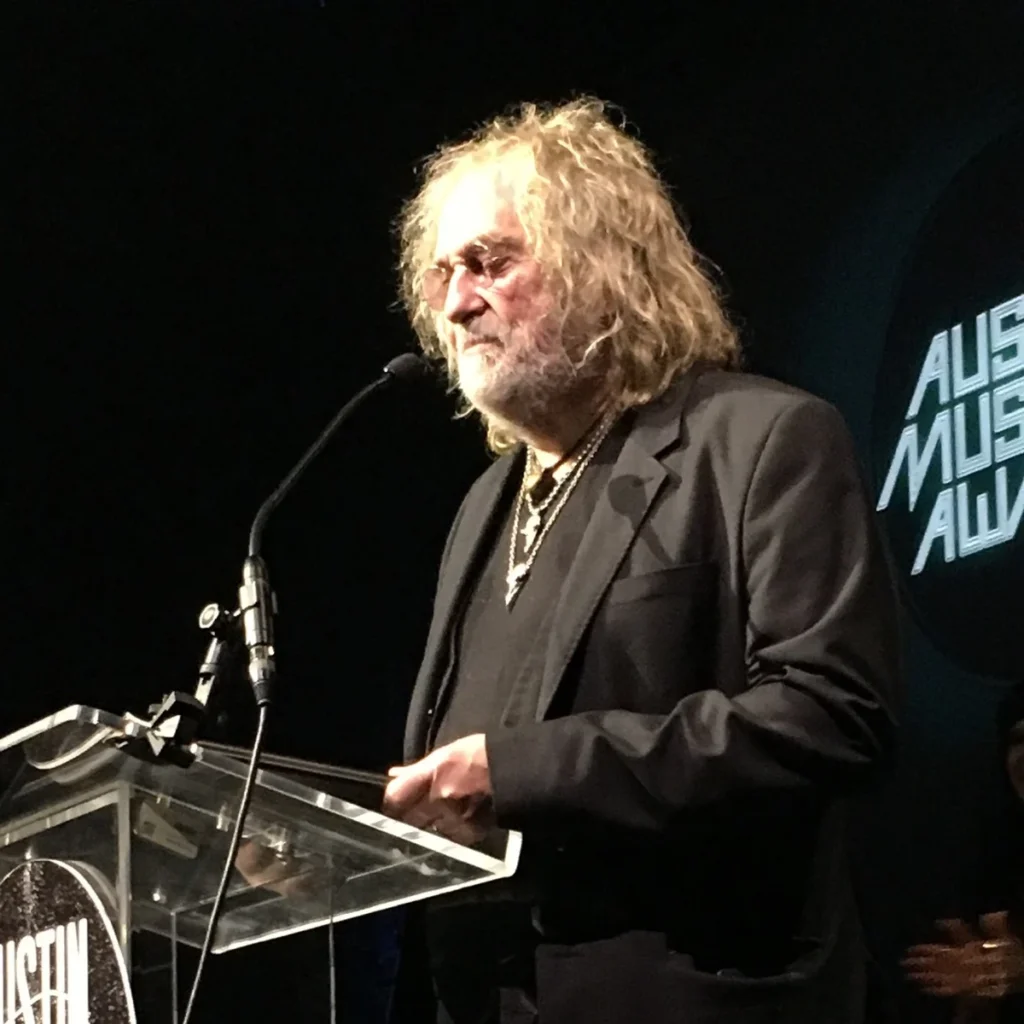
Ray Wylie Hubbard at the Austin Music Awards.
Ray Wylie Hubbard at the Austin Music Awards.
The last two songs on Reel 2 Reel 4 Real were recorded in a studio off Ventura Boulevard in Los Angeles, about fifteen hundred miles from where the rest of the record was made. They are there because of a phone call Ray Wylie Hubbard did not expect, from a guitarist he had never worked with, prompted by a conversation with a Beatle.
The album arrived on 21 August through Bordello Records, released with Soundly Music and Thirty Tigers. It runs ten songs and about forty minutes, and eight of them were cut at producer Jonathan Tyler’s studio in Austin. Three of those eight went to tape with no computer involved, which is where the title comes from. This one is louder than most of the records Hubbard has made.
The running order is “Cassette Mix Tape,” “El Diablo Esta Ganando,” “A Murder of Crows,” “Look What The Cat Drug In,” “Dog or Wolf,” “Tip Your Hat to the Black Crow,” “Gods Playing Poker,” “Cobwebs,” “She Plays ‘Crazy Mama'” and “The Night.” Videos went out ahead of release for three of them. None of the ten runs long, and the sequence keeps the two Los Angeles tracks for the end, so the record changes rooms without announcing it.
A Phone Call That Started With Ringo Starr
Hubbard has told the story to several outlets, and the version he gave Grateful Web is the plainest. Mike Campbell, who spent decades as the guitarist in Tom Petty and the Heartbreakers, rang him out of nowhere. “He said, ‘Ray? It’s Mike Campbell. I was over with Ringo, and your name came up, and I told Ringo I really liked your writing,'” Hubbard recalled. The invitation followed: come to Los Angeles, cut a couple of songs.
He went. Campbell played on the two closing tracks, and Steve Ferrone, another Heartbreakers alumnus, sat behind the drums. It is a strange piece of provenance for a Texas record, and Hubbard does not pretend otherwise. The songs were already written and the band in Austin had already done the heavy lifting. What Los Angeles added was a pair of players who had spent their careers making guitars sound enormous without making them sound busy.
Why Three Songs Went Straight to Tape
The tape decision was not planned as a statement. Hubbard went into Tyler’s studio intending to cut demos, and the sound that came back changed his mind about what the sessions were for. “We played it, and I thought, ‘Man!’ I just loved that sound,” he told Grateful Web. The demos became the album.
Three songs were committed directly to tape: “El Diablo Esta Ganando,” “Dog or Wolf” and “Tip Your Hat to the Black Crow.” Recording that way removes the option of fixing a performance afterwards, which is the point. It also flattens the distinction between a rehearsal and a take. The remaining tracks were recorded conventionally at the same studio, and the difference between the two methods is audible mostly as a kind of impatience — the tape songs do not wait around.
There is a practical argument underneath the romantic one. Tape imposes a running order on the day: the band has to be ready at the same time, the arrangement has to be settled before the machine rolls, and a player who wants a second attempt has to talk the room into it. Those constraints tend to produce shorter songs and fewer overdubs, and both are audible here. It is the same set of limits that shaped the records Hubbard grew up on, applied deliberately rather than inherited.
Hubbard’s assessment of the finished record, delivered to Saving Country Music, was characteristically sideways: “I’ll say it’s the best record I’ve ever heard.” He credited Tyler directly, calling him “a really brilliant producer and a great engineer.”
The Band Hubbard Built Around His Son
The Austin core is small. Kyle Schneider played drums, John Michael Schoepf played bass, and Lucas Hubbard — Ray’s son — played electric and resonator guitar. Lucas has been in his father’s band for years now, long enough that his presence has stopped being a novelty and started being structural. On a record this guitar-driven, the family arrangement is doing real work rather than supplying a story.
Around them, Tyler brought in players who know the material’s vocabulary. Cody Braun of Reckless Kelly added fiddle and mandolin. Bukka Allen played organ. Tobin Dale contributed guitar and slide. The result sits closer to garage rock than to anything filed under Nashville, and the reference points reviewers reached for — the Rolling Stones, Neil Young, Creedence Clearwater Revival — are all bands built on the same principle of a small group playing loudly in one room.
What the Songs Are Actually About
The opening track, “Cassette Mix Tape,” is a memory piece about a stolen car and the music that was playing in it. Elsewhere the writing does what Hubbard’s writing has done for fifty years, which is to take a grim proposition and find the joke inside it without softening the proposition. In “Gods Playing Poker” he offers that “those hard of hearing are either damned or blessed,” and follows it with a line about being broken flesh and blood beating the alternative.
The Rock and Blues Muse review picked out “Look What the Cat Drug In,” where a riff gets described as “funky as Jimmy Reed’s thin twin,” and “Cobwebs,” which measures a woman against the White Stripes’ reading of “Jolene.” These are not obscure references for their own sake. They are how Hubbard places a song — by naming the records it descends from and letting the listener do the arithmetic.
A Nod to JJ Cale, Sung by Someone Who Was There
“She Plays ‘Crazy Mama'” is the album’s clearest act of lineage. The title borrows a JJ Cale song, and the backing vocal comes from Christine Lakeland, who played with Cale for decades and was married to him. Getting her on the track turns a tribute into a first-hand account, which is a different and better thing.
That instinct — to go to the source rather than the imitation — runs through Hubbard’s catalogue and through the wider roots field. It is the same move a bluegrass player makes when he calls in the people who taught him, as Billy Strings did on his own recent album. The tradition is not an abstraction in this music. It is a list of phone numbers.
What “Probably My Last Album” Really Means
Hubbard turns eighty in November, and he has said this will probably be his last full-length. He told Saving Country Music he intends to keep releasing songs as he finishes them, one at a time, rather than assembling another record. That is less a retirement than a change of format, and it is a reasonable one for a writer whose songs have never needed a twelve-track container to make sense.
It also explains the volume. A last album made quietly would have been a summing-up. This one is not that. It was tracked fast, partly to tape, by a small band with the writer’s son on guitar and two Heartbreakers on the end of it, and it sounds like a man who found a noise he liked and saw no reason to turn it down.
It landed on one of the busiest release days the format has had this year. Keb’ Mo’ put out The Breakdown on Concord the same morning, Grace Potter released Trespasser, and the Po’ Ramblin’ Boys delivered Welcome to the Club, alongside records from Cory Branan, Pieta Brown and Adam Chaffins. A crowded Friday is usually bad news for a veteran act competing for attention against younger ones.
In this case it reads more like company. Every one of those records was made by an artist working outside the country-radio system, most on independent labels, several cut fast with small bands. Hubbard has been operating that way since long before it was a strategy. The difference now is that the method has a scene around it, and a last album is a reasonable moment to notice that.
About The Author

 Maybe Magic by Ryan Sweezey and a Decade of Unfinished Songs: The Long Version
  Where Deep Blue Sea Came From: Kadi Beth and a Mayday Call Over Dark Water
  Backyard Getaway by Emily Fraser, a Pop-Country Escape: The Long Version
  Why New Orleans Blues Rock Survived the Move to Switzerland on Rising by Jeb Rault
  Where I Asked Jesus & He Said No Came From: The Martha Groves Perry and Pat Thrall Protest Single
  Brandi Carlile’s Ted Lasso Theme Is the First Sung by a Woman