
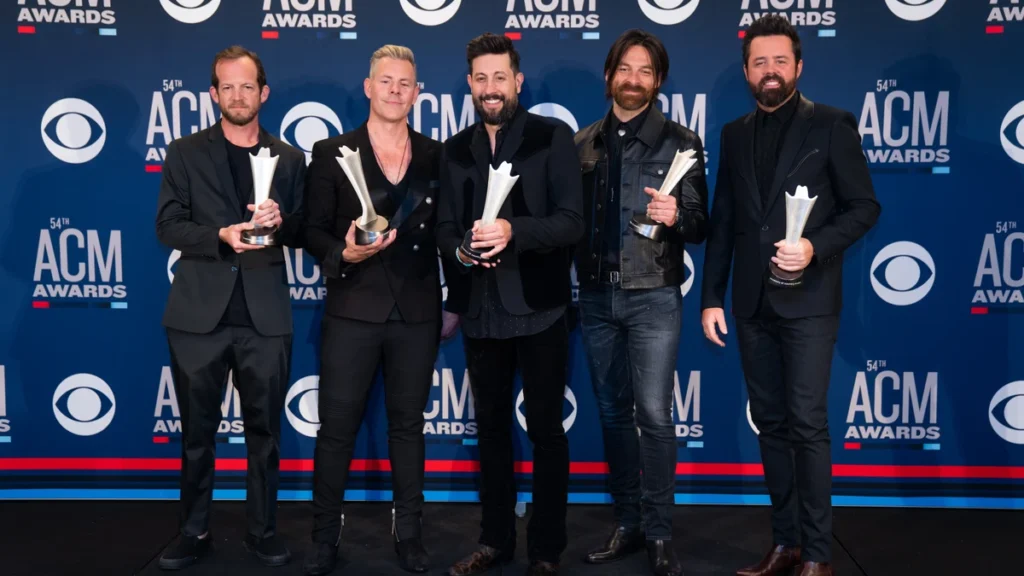
Old Dominion with their Vocal Group of the Year awards at the ACM Awards.
Old Dominion with their Vocal Group of the Year awards at the ACM Awards.
Old Dominion’s sixth album is called Barbara and there is no Barbara. The band made her up, and their explanation of why is the least reverent thing said about an album this year: “It’s like naming your dog Gary. You don’t know that many Barbaras out there.”
The record came out on 22 August 2025 through Sony Music Nashville, thirteen tracks. It is also, by the band’s own account, the most personal thing they have made, which makes the joke on the cover a strange front door for it.
How the Name Happened
It was not a concept that arrived fully formed. “We always have a running list of album titles, and this whole idea came up of naming it a person’s name,” Matthew Ramsey told American Songwriter.
Bassist Geoff Sprung remembers the last convert. “Brad was kind of the last holdout. And then at the last minute, he was like, I think we should call it Barbara.” Brad Tursi, the holdout, produced the winning name.
What they settled on is a character rather than a person: “a woman that’s been through a lot. She’s mature, she still knows how to party. Trash and sophisticated all at the same time.” That is a description of a record as much as a woman, which is presumably the point.
The Songs That Are Not Jokes
“Miss You Man” is written for Andrew Dorff, the Nashville songwriter and friend of the band, who died before the record was made. It is the album’s plainest thing and the reason the personal framing is not marketing.
“Goodnight Music City” looks back at the band’s own route through Nashville. “Man Or The Song” asks a harder question about what a career does to a person. “I think everybody can get lost in whatever their career is, or the caricature of themselves,” Trevor Rosen told MusicRow.
Ramsey puts the change simply. “Our songwriting just got a little bit more honest, naturally, I think,” he said, and elsewhere: “I think we’re just less afraid to put more personal notes in now — and maybe even excited by that idea.”
“Naturally” is carrying weight in that sentence. He is not describing a decision to make a serious album; he is describing what happened to the writing once the people doing it had been in a room together for long enough. That is a different and more believable account of how bands change.
The rest of the track titles keep the register mixed. “Making Good Time”, “Water My Flowers” and “Coming Home” are recognisably the band that made the radio hits, and they sit alongside the elegy and the career reckoning without anyone smoothing over the join. An album called Barbara can hold both, which is presumably why she is described the way she is.
Taking the Chorus Apart
The lead single, “Me Most Nights”, was written by Tursi, Rosen, Ramsey and Ross Copperman, and its construction is the most interesting technical thing on the record. “It started with the title,” Ramsey said. “And then the way we continually kept turning that into a new phrase — that’s just how we think as songwriters.”
Tursi describes what happened next. “At the end of the session we basically deconstructed the whole thing. The chorus ended up being like the anti-chorus.” Ramsey adds that they gave it “a little bit more of a rock kind of edge”, ending with the instruments dropping away.
An anti-chorus is a deliberate risk for a band with nine number ones at country radio, a format built on the opposite instinct. Writing a hook and then dismantling it is what a group does when it has enough credit to spend some.
The subject is equally unglamorous. “This is Me Most Nights,” Ramsey said, “just feeling, you know, lonely or sad.” From a band whose reputation rests on melodic, good-humoured radio songs, that is a lead single chosen against type.
The Difficulty of Writing the Same Thing Again
Ramsey is candid about the problem a sixth album presents. “Our challenge as songwriters is to find a new way to write about the same things,” he said of “Water My Flowers”.
He is equally candid about failing to enjoy the process. On “What Doesn’t Kill A Memory”: “It took us a minute to commit. It wasn’t like that in the studio for the longest time, and I felt like a stick in the mud in that session.”
Bands rarely admit to being the obstacle in their own room. That he does explains something about how this group has stayed together long enough to reach a sixth record with the same writing core intact — the four names on the singles have not changed.
The Awards Problem
Old Dominion have won eight consecutive ACM Group of the Year awards and seven consecutive CMA Vocal Group awards, alongside twelve RIAA gold and platinum certifications and nine number ones at country radio.
That is a difficult position from which to make a personal album. A group that wins the same award every year is being rewarded for consistency, and consistency is precisely what a record about mortality and lost friends has to break.
The nominations have continued regardless — an eleventh consecutive nod in the ACM group category, on top of the eight straight wins. Whatever risk the band took with the writing, the institution that keeps rewarding them has not yet registered it, which is either a compliment or the problem, depending on how you read it.
Five members, one writing core, six albums and no line-up change is itself unusual in a format that grinds groups down. Country radio has never had many bands, and the ones it does have tend to be built around a single voice with interchangeable players behind it. Old Dominion is a real band, which is why a song like “Man Or The Song” can be asked collectively rather than by a frontman about himself.
Their route through the mid-2010s ran alongside the format’s most commercially engineered period, and the songs that built the run were melodic, funny and radio-shaped. Dierks Bentley solved the same mid-career problem by handing most of his writing away; Old Dominion kept the writing and changed what it was about.
A Tour That Will Not Stop
The How Good Is That world tour has run through the United States, Canada, Europe, Australia and New Zealand, and Pollstar reported its extension into 2026.
March takes in Perth’s Red Hill Auditorium, Melbourne’s Margaret Court Arena, the ICC Sydney Theatre and CMC Rocks QLD in Ipswich, then Auckland’s Powerstation and Christchurch Town Hall. Canada follows from late April — Hamilton, Ottawa, Quebec City, Winnipeg, Saskatoon, Kelowna, Vancouver and Victoria — running to 6 May.
Alexandra Kay opens the Australian and New Zealand dates, Dasha joins selected Australian shows, and Phil Vassar and Sacha take the Canadian leg. Ramsey’s summary of the year behind it is unaffected: “We have had the time of our lives playing the hits and introducing Barbara across America this year.”
That sentence contains the album’s whole strategy. The hits are the reason the room is full; Barbara is what they do once it is. Naming her after nobody was the cheapest possible way to signal that the band knows the difference.
About The Author

 Why the Glockenspiel Survived: Bed by Stacy Henle and the Craft of a Quiet Folk Single
  Maybe Magic by Ryan Sweezey and a Decade of Unfinished Songs: The Long Version
  Where Deep Blue Sea Came From: Kadi Beth and a Mayday Call Over Dark Water
  Backyard Getaway by Emily Fraser, a Pop-Country Escape: The Long Version
  Why New Orleans Blues Rock Survived the Move to Switzerland on Rising by Jeb Rault
  Where I Asked Jesus & He Said No Came From: The Martha Groves Perry and Pat Thrall Protest Single