
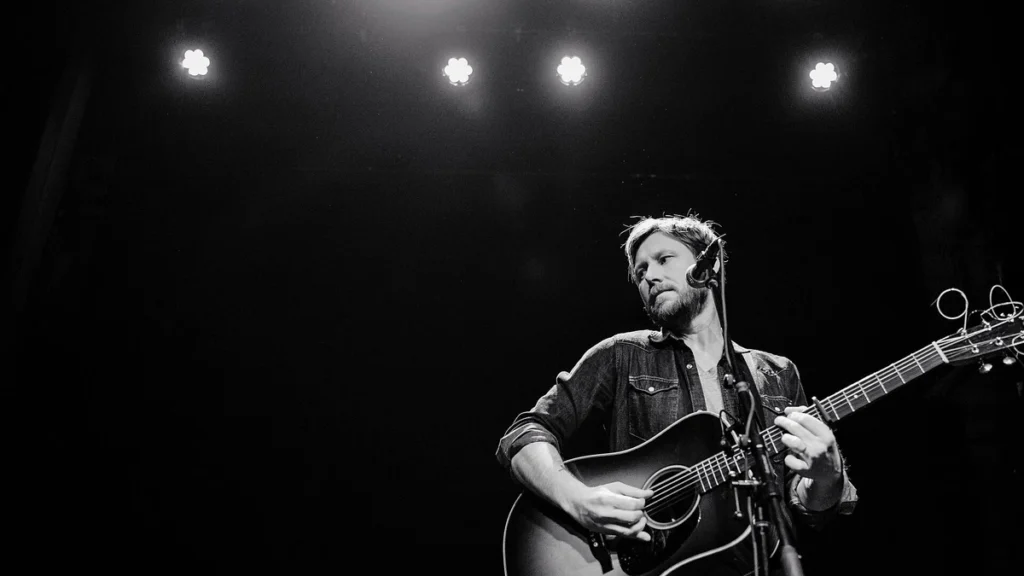
Cory Branan performing in Brooklyn.
Cory Branan performing in Brooklyn.
Most songwriters keep a folder of songs that did not make the record. Cory Branan kept his for two decades, then put ten of them out as an album. You’ll Live arrived on 21 August through Blue Élan Records, and every song on it was once cut from something else.
His own description, given in the label’s announcement, is four words long. “This is an orphanage.” It is the most accurate summary anyone has offered of the record, and it explains both what is good about it and what reviewers have found frustrating.
What an Orphanage of Songs Sounds Like
The songs were written across roughly twenty years, each one set aside because it did not belong on whatever album Branan was assembling at the time. That is a different selection principle from the usual one. A normal album collects songs that agree with each other; this one collects songs that agreed with nothing, which means the only thing they have in common is that they are his.
The result is exactly as varied as that implies. Americana Highways was blunt about it, warning listeners not to expect a focused album because it is a potpourri. That is a fair reading of the track list. It is also, arguably, the point: a record of offcuts that sounded like a coherent statement would mean the offcuts were never really offcuts.
Memphis Habits in a Nashville Room
Branan is from Memphis, and the writing carries the mixture that city produces — Southern narrative detail sitting next to a punk band’s sense of timing. Glide Magazine‘s John Moore traces the outsider swagger in his delivery back to a punk and metal background, which is the unglamorous truth behind a lot of writers filed under americana.
The record was made in Nashville with Anthony da Costa producing. Da Costa also plays across it — guitars, mandolin, synth — alongside Adam Abrashoff on drums, James Haggerty and Will Honaker on bass, Matt Rowland on piano and organ and Kai Welch on accordion. It is a full band making arrangements for songs that in some cases predate the players’ involvement by fifteen years.
That is the technical achievement here and it is easy to miss. A song written in 2007 and one written last year do not naturally sit in the same sonic space; something has to be done to make them belong on one disc. The answer taken was to record them all the same way with the same people, so the room becomes the common element rather than the writing.
The Songs That Work Hardest
“Teeny Says” opens the album as an amped-up pop-rock track, guitars and drums steady under an organ line. “Kathleen”, released first, is the one built to stick — Glide calls it a peppy, emotionally conflicted singalong, which describes a specific and difficult thing to write. “Cold-Blooded Love” slows to a waltz. “The Price and the Cost” goes darker, a cautionary tale about falling in with the wrong people.
“Me and Your Mom and Them” is about fatherhood and rides an up-tempo boogie-woogie piano, and it is the clearest evidence that these songs were not discarded for being weak. It is among the catchiest things on the record. It simply had nowhere to go on an album about something else.
“Ricochet”, “What Gave Me Away” and “Queen and Country” fill out the middle, and “The Nothing I Know” takes the set to its most solemn point. Across ten tracks and under thirty-four minutes, nothing outstays its purpose — a side effect of songs that were each written to do one job inside a different record.
The bass credits are worth a second look, because two players share them: James Haggerty and Will Honaker. On a conventional album that would suggest a scheduling problem. Here it is more likely a consequence of the material, since songs assembled from different eras carry different demands, and a set built over twenty years has no reason to expect one player to suit all of it.
Tyler Childers, a Mandolin and a Little Zydeco
“Steppin’ Outside” carries a guest vocal from Tyler Childers and went out as a single ahead of the album. The arrangement is coloured by mandolin with a zydeco lean, which is not a combination Branan’s catalogue would have predicted, and it works because nobody is trying to make it sound inevitable.
Guest appearances on records like this usually serve a marketing function. This one does something more useful: it puts a second voice on a song from a set that has no other unifying voice, and in doing so marks the track as belonging to this album rather than to the one it was originally written for.
The timing is worth noting too. “Steppin’ Outside” went out the previous autumn, well ahead of the album announcement, which is an unusual way to trail a record that did not yet have a shape. It suggests the song existed before the decision to build an album around the archive, and that the archive idea followed from having released one of its inhabitants and finding that it stood up alone.
A Steamboat Explosion as a Closing Track
The album ends with “The Wreck of the Sultana”, a narrative song about a steamboat explosion on the Mississippi in the eighteen hundreds. Disaster ballads are one of the oldest forms in American roots music, and putting one last on a record of orphans is a deliberate piece of sequencing — the most traditional song in the set is the one that closes it.
It also connects Branan to a habit visible across the format this year. Elizabeth Cook built songs around the Manhattan Project and a 1971 chemical plant explosion on her own August release. Writers working outside country radio keep reaching for documented catastrophe, probably because it offers narrative stakes that a love song has to manufacture.
There is a craft reason as well as a thematic one. A disaster ballad comes with its own structure — the ordinary morning, the failure, the count afterwards — so the writer inherits a shape and can spend the effort on detail instead. For a song that had to survive twenty years in a drawer before finding a home, an inherited structure is a considerable advantage. It is the sort of song that does not date, because it was never current in the first place.
Why the Record Deserves More Than It Will Get
Glide’s verdict was that the album is further proof, as if it were needed, that Branan deserves a much wider audience. That sentence has been written about him for most of twenty years, and the fact that it is still being written is the whole problem. A songwriter who consistently gets that notice and never converts it usually has a structural reason, and in this case the reason is visible in the record itself: he does not make records that fit anywhere.
The compensation is a catalogue that ages unusually well. Songs cut for not matching an album’s mood are not weak songs, and hearing ten of them together makes the case better than a tidier release would. It is the same argument made by Ray Wylie Hubbard’s late Austin sessions — a writer who has stopped optimising for a format tends to produce his most durable work.
It is his second release for Blue Élan, and the pairing makes sense. A label built around catalogue artists rather than chart cycles is the only kind that would fund an album of rejected songs, because the proposition only works if the measure of success is the depth of the back catalogue rather than the first-week number. Branan has spent his career being the wrong shape for the other model.
You’ll Live runs a little under thirty-four minutes. It is not a summary of a career and it is not trying to be. It is a filing cabinet, opened once, in public — and the songs inside it turn out to have been waiting rather than failing.
About The Author

 Maybe Magic by Ryan Sweezey and a Decade of Unfinished Songs: The Long Version
  Where Deep Blue Sea Came From: Kadi Beth and a Mayday Call Over Dark Water
  Backyard Getaway by Emily Fraser, a Pop-Country Escape: The Long Version
  Why New Orleans Blues Rock Survived the Move to Switzerland on Rising by Jeb Rault
  Where I Asked Jesus & He Said No Came From: The Martha Groves Perry and Pat Thrall Protest Single
  Brandi Carlile’s Ted Lasso Theme Is the First Sung by a Woman