
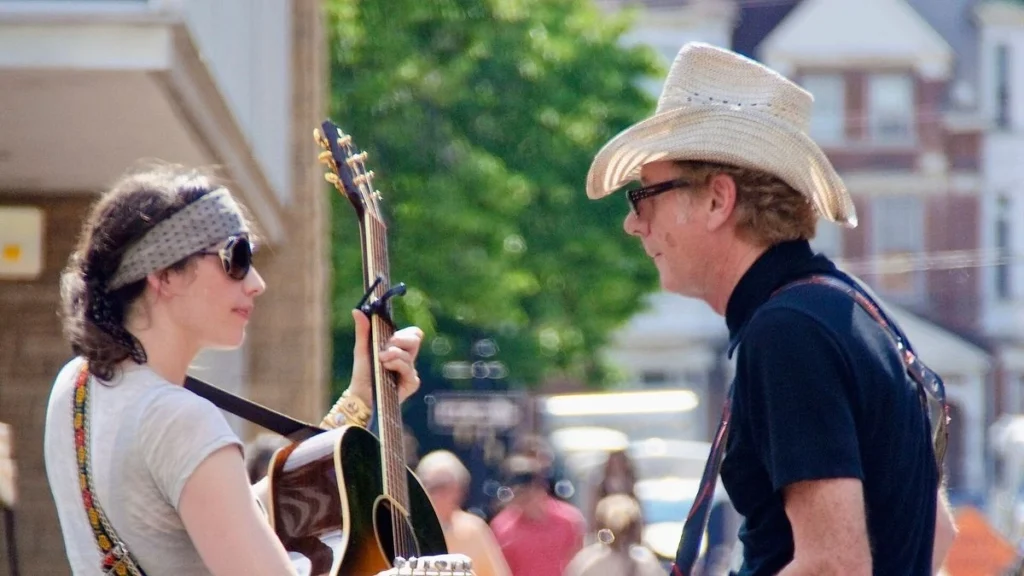
Pieta Brown performing with Bo Ramsey.
Pieta Brown performing with Bo Ramsey.
The two people who produced Dreamin’ Of with Pieta Brown are better known for a different kind of record. S. Carey and Mike Lewis both came up through Bon Iver, a project built on treated voices and long decay. Brown writes plain-spoken songs with a guitar. The interesting thing about her ninth album is how little either side had to give up.
It arrived on 21 August through Righteous Babe Records, ten songs long. Brown produced it with Carey and Lewis, who also play as the rhythm section, and it was recorded in northern Minnesota across two rooms — Justin Vernon’s studio and Lewis’s own basement — with Brett Bullion engineering.
Two Rooms in Northern Minnesota
Splitting a record between a purpose-built studio and a basement is not usually a stylistic choice; it is usually a budget. Here it shows up in the finished sound as a genuine range. The Americana UK review describes the opening track, “Time Of The Night”, as beginning with strings over an acoustic bass that sits open, reverberant and unusually high in the mix — the sort of decision a room encourages rather than a producer imposes.
That bass placement is worth dwelling on, because it is the clearest fingerprint the producers leave. In most americana mixes the upright is felt more than heard. Pushed forward, it stops being a foundation and becomes a voice, which changes what the guitar has to do. Brown’s picking can then sit lighter, and her singing does not have to carry the whole middle of the frequency range.
The two-room split also explains a quality the record has that is hard to name — a sense that some songs are being performed and others overheard. A basement has no separation and no natural reverb worth using, so what it captures is proximity. A built studio can manufacture distance. Sequencing tracks from both across one album gives the cycle a variable focal length, and it is used deliberately rather than smoothed away in the mix.
Brett Bullion’s role sits across that seam. He engineered the record and is also credited with ambience and effects, which is an unusual pair of jobs to hold at once. It means the person capturing the room is also the person deciding how much room there should be — a shortcut that tends to produce coherence, because there is no handover between the recording of a sound and the treatment of it.
Songs That Circle Rather Than Argue
The ten tracks are organised as a cycle around nature, love, loss, war and addiction. That list reads like an overreach on paper. In practice the songs approach those subjects sideways, which is why the record holds: “Nothin’ But Trouble” is the longest song here, built on strummed acoustics and slide, and it delivers its warning as family lore rather than argument — mama was right, it is fine to have fun, but there is nothing but trouble on either side of a gun.
“Was The One” pairs melancholy writing about love and sadness with treated drums and washes of electric guitar, and resolves into an indie guitar solo that would sound out of place on a more traditional roots album. “Someday Someday”, “Laura”, “Love Letters” and “So This May I” fill out the sequence. None of them announce a theme; they accumulate one.
Calling a record a song cycle is usually a way of excusing an album that does not have singles on it. The claim is more defensible here because of how the subjects are distributed. War and addiction are not given their own tracks to be dealt with and set aside; they surface inside songs that are ostensibly about something else, which is how those subjects actually behave in a life. The cycle is in the recurrence, not in a narrative running front to back.
It is also a quietly unfashionable way to release music in 2026. A ten-song set designed to be heard in order runs against every incentive of playlist distribution, where the unit is the track and the reward goes to whatever survives being pulled out of context. Brown has made the version of the record that works least well when shuffled — which is a choice, and a legible one.
What the Amos Lee Duet Does
“Drinkin’ Side” opens with unaccompanied voices before a slow blues figure comes underneath, and it is a duet with Amos Lee. Their voices blend closely enough that the track briefly stops sounding like a guest appearance and starts sounding like a band.
Brown’s own account of it is short. “Something freeing happens when we sing together,” she said in the album announcement. Placed against a slow blues, that freedom reads as permission to under-sing, which is the harder discipline and the one the song needs.
The Title Track Came Out of a Fever State
Brown has described writing the title song in what she called a dream-like fever state, late at night, after reading an article about a father urging love. Her broader explanation of what songs are for is looser and more characteristic: they give us open places to dream, different kinds of worlds, a collective medicine of frequency.
That is not the vocabulary of a writer chasing a format, and it maps onto the record. “Dreamin’ Of” itself moves on wafting keys and picked electric guitar, carries harmony vocals, and makes room for a saxophone solo that Americana UK calls mellow and tasteful. A saxophone on an americana single is a small act of defiance, and it passes without fuss.
“Glitter Town” and the Pop Edge
The most immediate song is “Glitter Town”, the first single, and the one Americana UK likens to The War On Drugs — a comparison the lyric invites, since it name-checks that band alongside Otis Rush. Naming your influences inside the song is a risky move that usually reads as insecurity. It works here because the two names describe the actual distance the record travels: a modern, reverb-heavy American rock band and a Chicago blues guitarist.
The wider cast supports that spread. Jeremy Ylvisaker plays guitar, Bullion contributes ambience and effects, and Bo Ramsey, Brown’s long-time collaborator, appears alongside Bertrand Belin, Barbara Jean Meyers, Bryan Vanderpool and Romain Collin, as Grateful Web’s account of the release sets out. It is a larger company than her records usually carry, assembled without turning the songs into productions.
Nine Albums In, Still Recognisably Herself
Americana UK gave the record eight out of ten and noted that although there has been a long gap between releases, the continuity of label and band gives the album a palpable assurance. That is the useful observation. Brown has not spent the interval reinventing herself, and the producers she chose did not arrive with a plan to modernise her.
What they brought instead was a set of decisions about space — where the bass sits, how much room a voice needs, when to let ambience do the work a second guitar would otherwise do. Those are production choices, not writing ones, and they leave the songs intact. It is the same principle visible on Ray Wylie Hubbard’s latest, where an outside producer changed the sound of a record without touching what the writer does.
The Bon Iver connection will be the line most coverage leads with, and it is the least interesting fact about the record. What matters is not the association but the specific competence those two players brought: an ear for how much silence a song can hold. That skill happens to have been developed on records that sound nothing like this one, which is why the pairing produced something rather than merely a crossover.
A ninth album rarely converts anyone. This one is not built to. It is built for the listeners Brown already has, and made by people who understood the assignment — which, on the evidence of the mix, was to get out of the way of a writer who had already done the difficult part.
About The Author

 Why the Glockenspiel Survived: Bed by Stacy Henle and the Craft of a Quiet Folk Single
  Maybe Magic by Ryan Sweezey and a Decade of Unfinished Songs: The Long Version
  Where Deep Blue Sea Came From: Kadi Beth and a Mayday Call Over Dark Water
  Backyard Getaway by Emily Fraser, a Pop-Country Escape: The Long Version
  Why New Orleans Blues Rock Survived the Move to Switzerland on Rising by Jeb Rault
  Where I Asked Jesus & He Said No Came From: The Martha Groves Perry and Pat Thrall Protest Single