
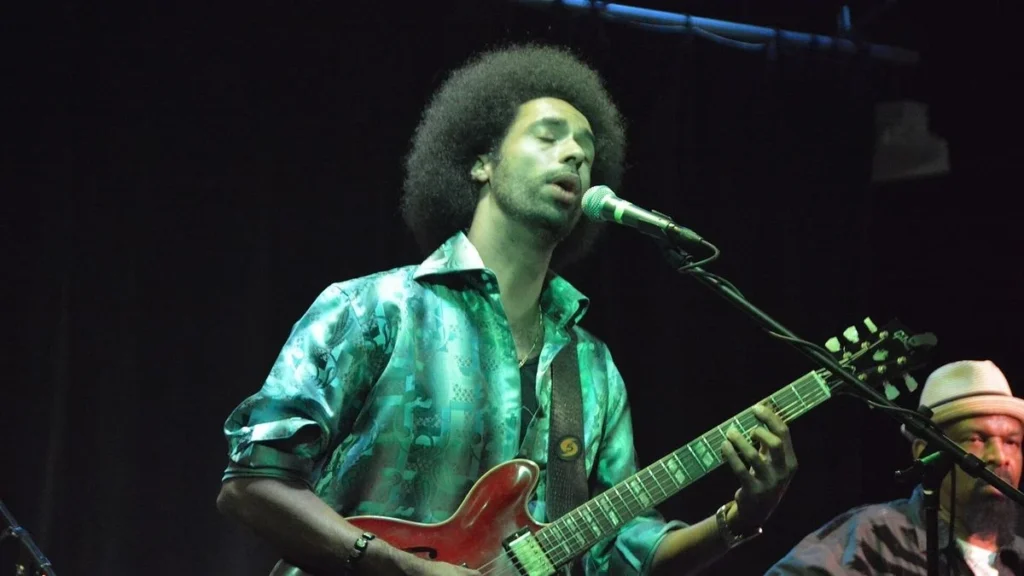
Selwyn Birchwood performing.
Selwyn Birchwood performing.
Blues albums do not usually open with dial-up modem static. On Electric Swamp Funkin’ Blues, released 27 March through Alligator Records, Selwyn Birchwood uses it to introduce a song called “All Hail The Algorithm”, and the joke tells you what kind of record this is going to be.
It is the first album he has produced himself for the label, ten original songs written and recorded in Florida. Taking the chair changed the result audibly. “Producing allowed me to really take the wheel and steer the music to the exact destinations that I wanted to go,” he said when announcing the record, adding that you would be hard pressed to find an album or a band that sounds exactly like his.
A Blues Band With Four Saxophones in It
The claim about the band is close to literally true, and the personnel list is where it shows. Regi Oliver plays baritone, tenor, alto and bass saxophone plus flutes. Eli Bishop supplies violin, viola and cello, multi-tracked into something larger. John Hetherington covers Hammond B3, piano and keys, with Donald “Huff” Wright on bass and Henley Connor III on drums.
Birchwood himself plays guitar, vocals and lap steel. Briana Lutzi and Taylor Opie sing behind him. That is a substantially larger palette than a modern blues quartet, and it is the palette a self-producing artist chooses when nobody is asking him to keep the sessions cheap.
The saxophones do most of the identity work. A horn section in blues normally means a Memphis soul revue arrangement; four reeds played by one man, doubling flute, produces something closer to a small jazz orchestra. On “Labor Of Love” it resolves into a baritone sax solo that carries the emotional weight the lyric is too plain to state.
The Title Track Is a Church Service
After a brief instrumental opener, “The Eagle Has Landed”, the album proper begins with “The Church of Electric Swamp Funkin’ Blues”. Glide Magazine describes it as a jubilant, non-judgmental gathering built on funky organ, horns and screaming guitar, with a vocal delivery that recalls George Clinton.
The lyric supplies its own thesis in one line: we don’t throw rocks, but we get stoned. That is a joke, a doctrine and a genre description at once, and it establishes the record’s central conceit — a congregation defined by what it declines to condemn.
Chicago Blues Guide hears the lap steel on the track reaching an intensity close to a sacred steel church service, which is the specific tradition the framing is borrowing from. Sacred steel is a real and living Black gospel practice, so the reference lands as lineage rather than costume.
Two Songs About the Internet
“All Hail The Algorithm” is a blues protest song about the digital age, and “Talking Heads” — which Glide rates the album’s best groove — takes on the news media and its half-truths over strong organ support. Both are unusual subjects for the form, and both work because they are written as complaints rather than as essays.
That is the correct instinct. The blues has always handled systems by describing what they do to one person: the landlord, the boss, the law. Recommendation engines and cable news are systems of the same kind, and treating them as a personal grievance rather than a policy problem keeps the songs inside the tradition.
There is a practical benefit too. Blues records built entirely on romantic disappointment compete with several thousand other blues records built on romantic disappointment. A song about being managed by a recommendation engine has almost no competition inside the genre, and it gives a listener a reason to pick this album over the reissue shelf.
The dial-up static is the clever part. A modem handshake is now a period sound — instantly nostalgic, and old enough that a listener under thirty may not recognise it. Opening a song about algorithmic control with the noise of a slower, dumber internet frames the whole complaint as something that arrived recently and could have gone differently.
The Guitar Playing Underneath
None of the conceptual material would matter if the playing were weak. “Should’ve Never Gotten Out Of Bed” runs on layered guitars and driving drums with the lap steel pushed into overdrive, and “Soulmate” is a slow song that both reviews single out for its vocal, carried by fierce work on a Flying V.
“What I’ve Been Accused Of” is a slow blues about suspicion in a relationship, with a piano solo from Hetherington and Birchwood switching to lap steel for a Chicago-flavoured feel. “Damaged Goods” is the most conventional thing here — an eighties-style self-examining love song in the Robert Cray manner, finished with a carefully built guitar coda.
The range is wide enough that the album could have come apart. What holds it is the lap steel, which appears in almost every register the record visits and functions as the recognisable voice across otherwise unrelated arrangements.
Lap steel is an unusual primary instrument for a blues bandleader, and that is precisely why it works as a signature. Played flat across the lap with a bar rather than fretted, it slides between notes continuously instead of stepping between them, which gives every line a vocal quality a fretted guitar has to imitate. On a record that moves from funk to sacred gospel to a slow Chicago shuffle, one instrument doing that consistently is the connective tissue.
It also explains the album title. “Electric swamp funkin’ blues” is not a genre anyone else uses, but as a description of lap steel played through amplification over Florida-inflected funk rhythms, it is close to a technical specification.
How the Album Ends
“The Struggle Is Real” closes the record as a gospel-folk hymn, and it is the only track that abandons the humour entirely. It describes struggles running from birth onward and the racial hatred that continues, and Chicago Blues Guide reads its final position as a combination of despair, resignation and hope.
Placing it last is a structural decision worth noting. An album that spent nine songs being funny, funky and technologically sceptical could easily have ended on a party. Ending on a hymn about race instead re-frames everything before it as the thing you do while the underlying problem stays unresolved.
It is a harder close than a blues record normally attempts, and it does not offer a resolution. That restraint is the same one Buddy Guy applied on “I Don’t Forget” at the other end of the generational scale: state the thing plainly, decline to console, stop.
What Self-Producing Actually Bought Him
Birchwood won the International Blues Challenge in 2013, which is what brought him to Alligator, and he has spent the decade since making records with outside producers. Chicago Blues Guide credits a self-released album with giving him the experience that made this one possible.
The gain is visible in the arrangements rather than the sound. A producer working to a budget does not book four saxophones and a multi-tracked string section for a blues record with ten songs on it, and would probably question a dial-up modem sample. Every distinctive decision here is one an outside hand would have smoothed.
Glide suggested the album deserves Grammy consideration, and Chicago Blues Guide concluded it amplifies his standing as one of the finest contemporary blues artists working. Both verdicts rest on the same thing: a player who has finally made a record that sounds like nobody else, by removing the person whose job was to make it sound like something.
About The Author

 Why the Glockenspiel Survived: Bed by Stacy Henle and the Craft of a Quiet Folk Single
  Maybe Magic by Ryan Sweezey and a Decade of Unfinished Songs: The Long Version
  Where Deep Blue Sea Came From: Kadi Beth and a Mayday Call Over Dark Water
  Backyard Getaway by Emily Fraser, a Pop-Country Escape: The Long Version
  Why New Orleans Blues Rock Survived the Move to Switzerland on Rising by Jeb Rault
  Where I Asked Jesus & He Said No Came From: The Martha Groves Perry and Pat Thrall Protest Single