
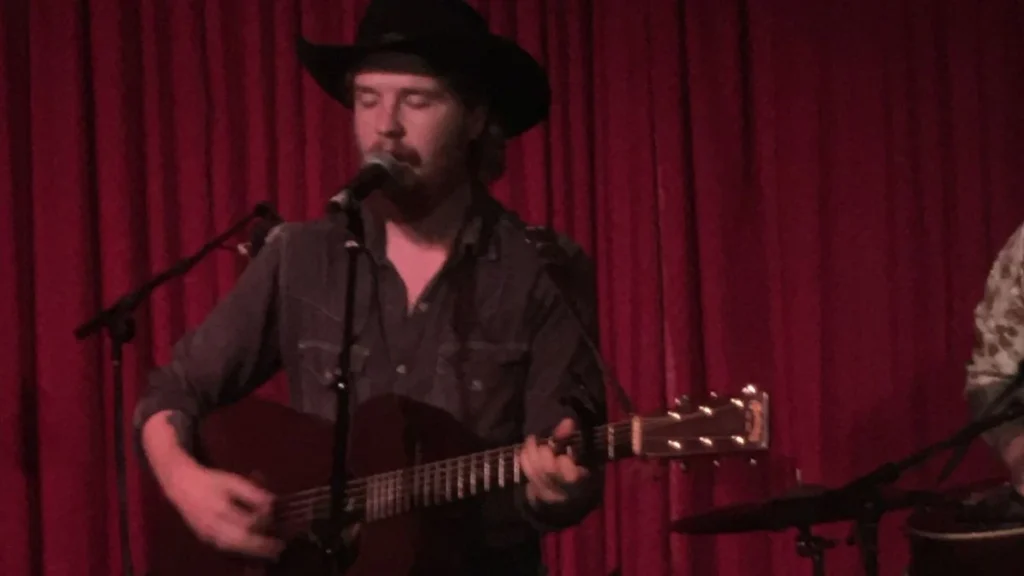
Colter Wall performing.
Colter Wall performing.
RCA Studio A in Nashville is the room where Waylon Jennings cut Honky Tonk Heroes, where Merle Haggard and the Strangers recorded parts of Hag, and where Willie Nelson worked more times than anyone has counted. Colter Wall booked it and filled it with drinking songs.
Memories and Empties came out on 14 November through La Honda Records and RCA, ten tracks and a little over half an hour. It is the first record he has made about bar-rooms rather than about horses, and the change of subject is the whole story.
Leaving the Cowboy Songs Behind
Wall built his reputation on Western material — cattle, prairie, the working life of a rancher — sung in a baritone that sounded older than he was. This album puts that down. Trigger’s Saving Country Music review, scoring it 8.3 out of 10, reads it as his first dedicated traditional country record: heartbreak, honky tonks and drinking rather than cowboy themes.
The opener sets the terms. “1800 Miles” is described in that review as a kiss-off to Music Row, which is a pointed thing to record inside Music Row’s most storied studio. Booking RCA Studio A to make an album about not needing Nashville is either a contradiction or a claim on inheritance, and the record treats it as the second.
The announcement of the album framed the ten songs as drinking songs and blue-collar stories about connection — to people, to nature, to time and to God. Wall has said the writing draws on 1970s country, which is precisely the era the room is famous for.
His Own Band, Not a Session Crew
He recorded with the Scary Prairie Boys, the group he tours with, and co-produced alongside Pat Lyons. That decision matters more in a historic studio than it would anywhere else, because the temptation in a room like that is to hire the players who made it famous and produce a tribute.
Holler’s review, which gave it 8.5 out of 10, lists what that band brings: tight fiddle licks, harmonica melodies, two-stepping basslines and church organ. It is a honky tonk instrumentation with a hymn hiding inside it.
Saving Country Music makes the production point precisely — the record avoids sounding overproduced and equally avoids the studied rawness that traditionalist records often mistake for authenticity. It simply sounds like a good band playing in a very good room.
The Title Track and the Ballads
“Memories and Empties” is the record’s centre and its clearest ballad. Trigger calls it a gorgeous vessel for Wall’s one-in-a-million voice and suggests it could make someone like Merle Haggard jealous, which in a review of an album cut in Haggard’s old room is doing a lot of work in one sentence.
“My Present Just Gets Past Me” follows the opener and turns on the disorienting sense of time that arrives with a broken heart. “The Longer You Hold On” and “Back to Me” occupy the same territory later in the sequence. None of them are built for a chorus you shout.
That is deliberate. The review notes there are no big bangers and no anthemic choruses on the record, and that the subtleties are what make the moments. An album of ballads recorded in half an hour is a confident thing to release in a format that rewards volume.
A Joke With a Very Long Title
“It’s Getting So (That a Man Can’t Go into Town Just to Have Him a Drink)” is the album’s up-tempo relief and its clearest homage. Titles of that length and construction belong to a specific period of country writing, and using one now is a way of signalling the tradition without covering anything.
It is worth saying that the joke is structural rather than decorative. A title that long has to be sung fast, which forces an up-tempo arrangement, which is exactly the change of pace the album needs at track five. The gag and the sequencing solve each other.
“Living by the Hour” works the blue-collar seam directly, and “Like the Hills” is the closest the record comes to an unambiguous love song — Holler quotes its promise to keep giving love in exchange for a last name. A deluxe pressing includes a vinyl-only alternate take of it.
“4/4 Time” is the strangest and possibly best thing here. Nearly five minutes long and, in Trigger’s description, almost gospel-like, it compares the writer’s craft to the divine one and hopes the Lord does not mind the borrowed metre — Holler quotes the line directly, and it is the wittiest thing on an album that mostly plays straight.
At just under five minutes it is also by some distance the longest track. On a record where the median song runs under three, giving that much room to the one song about songwriting itself is a quiet statement about what Wall thinks the album is for.
The rest move quickly. “Like the Hills” is over in two minutes twenty-one, and half the record clears three minutes. That economy is period-correct: the 1970s country Wall is drawing on was built for radio and jukeboxes, and neither rewarded a long song.
Why the Room Was the Right Call
Historic studios are usually a marketing decision. A booking at RCA Studio A buys a line in the press release and a photograph, and most records made there could have been made anywhere with the same result. This one has a better argument, because the album is explicitly built on a period the room defined.
Wall has said the writing draws on 1970s country. That decade at Studio A produced the records his album is in conversation with — the outlaw material Waylon cut, the working-man songs Haggard was writing. Recording where those were made is not reverence so much as putting the songs next to their sources and letting a listener check.
It also solves a technical problem. A room with that history has the acoustics that made those records sound the way they do, which is not something a plugin reproduces. For a band playing fiddle, harmonica, upright-feel bass and organ live, the space is effectively another instrument.
Ending on Ian Tyson
The closer is “Summer Wages”, written by the Canadian songwriter Ian Tyson, and it is the only song on the album Wall did not write. It is also the one moment where the Western material he set aside is allowed back in, since Tyson is the figure that whole tradition runs through for a Canadian singer.
Placing it last reads as an acknowledgement rather than a retreat. The record spends nine songs proving he can write honky tonk, then closes by naming the writer who taught him the other thing he does.
“Summer Wages” is also, pointedly, a blue-collar song — a gambler counting what he has lost against a season of work. Choosing that Tyson song rather than one of the cowboy standards keeps the closer inside the album’s subject even while it steps outside its authorship.
Holler’s summary is the fairest available: Wall is safeguarding country music’s tradition while pushing it forward, across a wider emotional range than his earlier work, balancing the laments with love and whimsy. It is a different route to the same destination Dale Watson took this year by simply refusing to leave the dance halls at all.
About The Author

 Maybe Magic by Ryan Sweezey and a Decade of Unfinished Songs: The Long Version
  Where Deep Blue Sea Came From: Kadi Beth and a Mayday Call Over Dark Water
  Backyard Getaway by Emily Fraser, a Pop-Country Escape: The Long Version
  Why New Orleans Blues Rock Survived the Move to Switzerland on Rising by Jeb Rault
  Where I Asked Jesus & He Said No Came From: The Martha Groves Perry and Pat Thrall Protest Single
  Brandi Carlile’s Ted Lasso Theme Is the First Sung by a Woman