
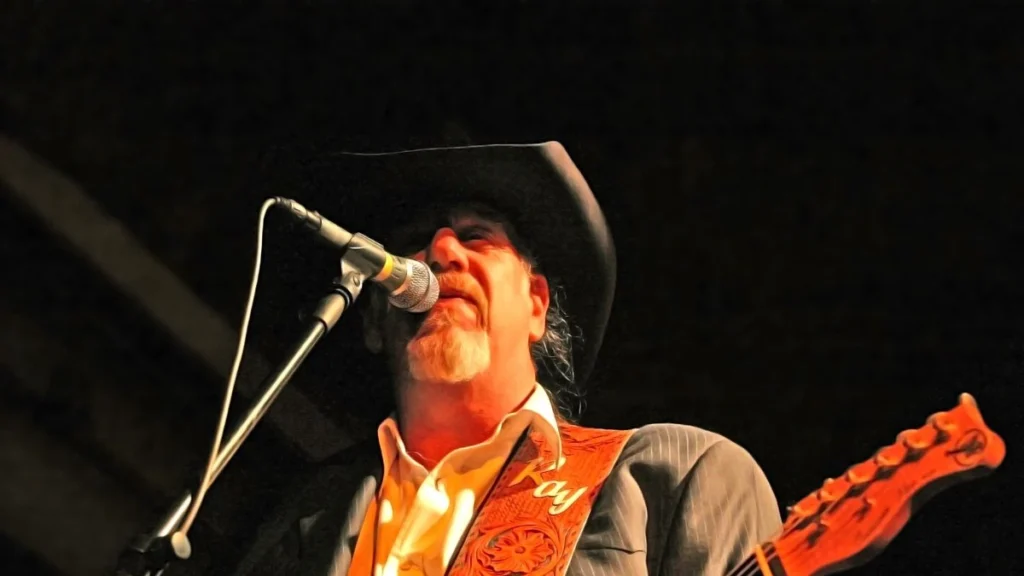
Ray Benson of Asleep at the Wheel performing.
Ray Benson of Asleep at the Wheel performing.
The band that spent fifty years keeping Bob Wills in print made an album about Texas and would not let a single Bob Wills song onto it. That was rule two. Rule one was that nothing they had already recorded could come back.
“We’re not going to do anything that we’ve already done,” Ray Benson told Cowboys & Indians, “so that eliminated a lot. And we’re not going to do any Bob Wills, because we’ve already done that.” Two sentences, and most of the obvious record was gone.
Two Rules and Twelve Songs
Riding High in Texas arrived on 22 August, the band’s thirty-second album. Benson picked the material with Sam Seifert, and the selection criterion he gave Texas Standard was not complicated: “the criteria was ‘does it have the word Texas in it?'”
Asked how he narrowed it to ten songs, Benson corrected the premise. “Well, we didn’t, because we have two bonus tracks.” Then, on how he got to twelve: “I have a Volume 2 coming up.”
What survived the rules is a cross-section of Texas songwriting rather than a greatest-hits set — Jimmie Rodgers, Guy Clark, Ernest Tubb, Charlie Daniels. “We weren’t trying to make Texas’ Greatest Hits,” Benson said. “That would have been too on the nose — and daunting. We picked songs that fit this group the best.”
What Western Swing Actually Is
The Bob Wills ban makes sense once Benson explains what he thinks the genre is, and his definition is the most useful thing in the interview. It is not a repertoire. It is a room full of specific instruments.
“The definition of a Western Swing band is the instrumentation: fiddle, steel, guitars, horns, piano, bass, drums,” he said. “If you stick to that, my idea is you can do any kind of music that you’re capable of doing. In other words, you might not be able to do Clair de Lune or Mozart, but you can do pretty much anything else.”
That is a working definition with consequences. If western swing is a line-up rather than a songbook, then a Wills tune is optional and a Guy Clark tune is not a departure. It also explains how the same band can spend five decades in one genre without repeating itself: the instrumentation stays fixed and everything else is available.
Benson resists the label anyway. “They always try to put you in a pigeonhole. We’ve always been put in the pigeonhole of being a Western Swing band. Or a Bob Wills band. And I’m happy to be there, but I always say, ‘No, we’re Asleep at the Wheel.'”
Long Tall Texan, and Why He Had the Right
Cowboys & Indians premiered “Long Tall Texan”, and Benson’s justification for cutting it is the funniest thing on the record’s promotional trail. “Well, I’m six-foot-six and I’m a Texan. So I figured, ‘What the hell? If anybody has the right to do this song, I do.'”
He also admits he did not know the song’s history until he checked. He had heard the Beach Boys cover, looked it up, and found the original was, he believes, by the Four Flickers, whose bass player Henry Strzelecki wrote it. “Anyway, I’ve known the song as long as I’ve lived.”
Lyle Lovett sings on it, and the pairing came from Seifert remembering Lovett had recorded the song once before with Randy Newman. “So I said, ‘Well, let’s get him to do it with us,'” Benson said. “Lyle is the greatest. I mean, what a talent.”
Billy Strings and the Peter Rowan Title
The title track is a Peter Rowan song, and Billy Strings plays on it. That is a bluegrass lineage arriving inside a western swing arrangement, and it is the clearest signal that Benson meant the instrumentation argument literally.
The other Texas standards do the historical work. “T for Texas” brings in Jimmie Rodgers; “Texas Cookin'” is Guy Clark; “All My Exes (Live in Texas)” is the George Strait dancehall hit; “Beaumont Rag” is the fiddle showcase. No Depression called the result “a 10-track groovy, joyful love letter to Texas” and “a rollicking, foot-stomping tribute to hard work, endurance, and a whole lotta swinging good times”.
The Ernest Tubb cut is “Texas in My Soul”, written with Zeb Turner, and it is where this record touches honky tonk directly. Tubb built that idiom, and covering him puts Asleep at the Wheel briefly in the same room as the dance-hall tradition that Dale Watson has spent his career defending. The lyric Benson lands on — “Partner, the rest of the world’s not worth a pound of good old Texas dirt” — is the album’s thesis in one line.
Ian Stewart and the Hundred Members
The album introduces Ian Stewart, a fiddler and vocalist and the newest name on a roster that has, by Benson’s estimate to Texas Standard, run to roughly a hundred musicians. The alumni list is a serious one: Tony Garnier, who has played bass for Bob Dylan for thirty-five years, along with Larry Franklin and Junior Brown.
That churn is usually a weakness in a band’s story and Benson has turned it into the operating model. A group defined by instrumentation rather than personnel can replace a fiddle player without becoming a different band, which is precisely what a fifty-five-year run requires.
It also makes the Bob Wills ban look less like a provocation and more like maintenance. The Wills repertoire is the material a new member would learn first and the material the band can already play in its sleep. Handing Stewart twelve songs nobody in the current line-up had cut before forces the whole group to arrive at the arrangements together.
Wills himself worked this way. The Texas Playboys were a revolving cast built around a fixed instrumental idea, and the leader’s job was to keep the sound constant while the players changed. Benson has run the same system for longer than Wills did, which may be the most Bob Wills thing about a record with no Bob Wills on it.
He is direct about what the record is for. “This album is an introduction to the current and future of AATW. I know another 55 years isn’t in the cards, but I want to keep pushing and creating as much as I can, for as long as I can. Ian and the new guys give me the motivation and energy to keep this going.”
The Word Nashville Deleted
Benson’s other running argument is about a hyphen. “I keep telling people, ‘OK, ladies and gentlemen, it’s country-western music.’ Nowadays, everybody’s wearing the god-dang cowboy hats. But let’s be real about this: Nashville eliminated the word ‘western’ from ‘country-western’ many, many years ago.”
He has a good anecdote to prove the point. At a Country Music Association awards show in the late 1980s or early 1990s, he counted the cowboy hats in the audience and found two: his own and Charlie Daniels’s. Daniels, as it happens, is one of the songwriters on this album.
The count has since reversed, and Benson is dry about it. Asked where Texas is these days, he agreed with the answer offered: everywhere. “Yeah, that’s a fact.”
That is the context this album lands in. Western imagery is currently the most fashionable thing in mainstream country, and the band that never abandoned it is releasing a record of songs the format spent thirty years defining itself against. Benson has been a Texan, by his own count, for fifty-three years, which is longer than the fashion has existed in either direction.
About The Author

 Miko Marks Opens Hell Or High Water at the Little Bighorn
  Hot Club of Cowtown Answered a Village Voice Ad and Stayed Thirty Years
  Marty Stuart Made a Surf Guitar Album on Clarence White’s Telecaster
  Turnpike Troubadours Covered Robert Earl Keen With Sierra Hull
  Jontavious Willis Shares a Ballot With John Primer and Jimmie Vaughan
  Jason Isbell Made an Album Alone With a 1940 Martin in Five Days