
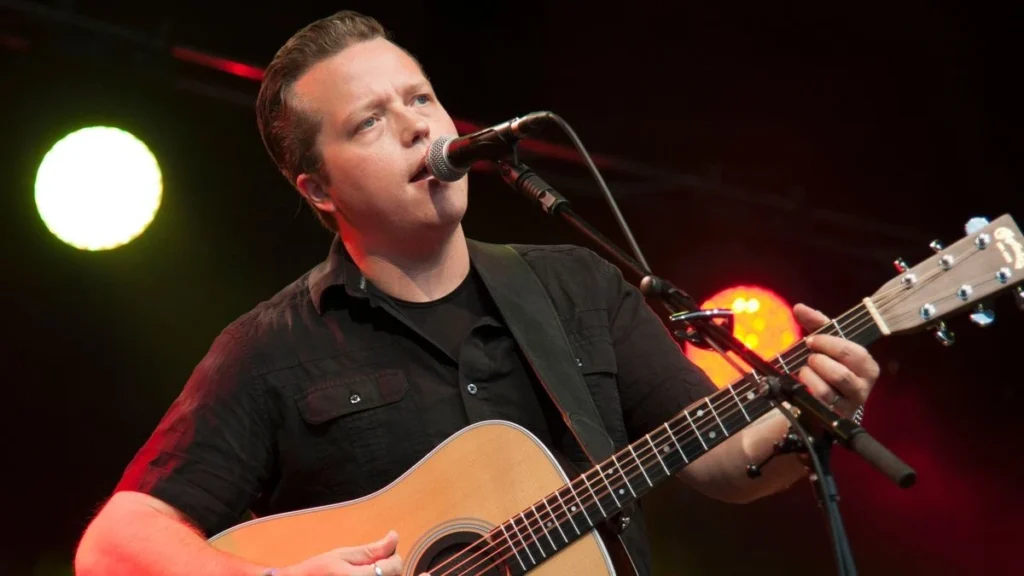
Jason Isbell performing at the Cambridge Folk Festival.
Jason Isbell performing at the Cambridge Folk Festival.
Five days at Electric Lady Studios, one 1940 Martin, and nobody else in the room. Jason Isbell’s tenth album is the first he has made entirely alone, and the arithmetic of it is the point.
Foxes in the Snow came out on 7 March 2025 through Southeastern Records — eleven songs, thirty-eight minutes, co-produced with Gena Johnson. It is his first record since 2007’s Sirens of the Ditch not to feature the 400 Unit.
The Guitar and the Five Days
The instrument is a 1940 Martin 0-17, an all-mahogany parlour guitar — small-bodied, dry, without the boom of a dreadnought. Rock Cellar Magazine confirms it is the only instrument on the album.
That choice determines everything else. A 0-17 does not fill a room, which means the voice has to, and it means a listener hears the fingers on the strings. On a record with no drums to hide behind, the guitar’s smallness is a decision about how exposed the singer wants to be.
Five days in October 2024 at Electric Lady is fast even by solo-acoustic standards. There is no time in that schedule for second-guessing an arrangement, because there are no arrangements — only takes.
Eleven Songs, Thirty-Eight Minutes
The sequence runs “Bury Me”, “Ride to Robert’s”, “Eileen”, “Gravelweed”, “Don’t Be Tough”, “Open and Close”, “Foxes in the Snow”, “Crimson and Clay”, “Good While It Lasted”, “True Believer” and “Wind Behind the Rain”.
Nothing runs past four and a half minutes. “Open and Close” is under three; the longest, “Ride to Robert’s”, is 4:25. An album this short from a writer with Isbell’s reputation for long-form narrative songs is itself a signal about the format he chose.
The cover art was painted by Anna Weyant, Isbell’s partner, and several of the songs are about the relationship the painting comes out of. A record that puts a new partner’s work on the sleeve and three songs about a divorce inside it is not trying to present a tidy account of anything.
Thirty-eight minutes is close to the length of a single vinyl side pair, and it is the length records were when the format still imposed a limit. Nothing about a streaming release requires that discipline, which makes it a choice: eleven songs is what he had, and there is no filler bought in to reach a rounder number.
The titles hold two registers at once. “Bury Me” and “Good While It Lasted” belong to one story; “Open and Close” and “Crimson and Clay” belong to another. Sequencing them together rather than in blocks means the record moves between the ending and the beginning the way a year actually does.
The Three Songs He Has Named
Isbell has identified “Eileen”, “Gravelweed” and “True Believer” as the tracks that address the end of his marriage. He has been direct about what they are: “With those three songs, especially, I’m trying to talk about a period in my life that was difficult, a lot of change. I got a divorce.”
What he has also said is that the goal was to look at the period as something more than a grievance. That is a harder brief than a breakup record usually sets itself, and it is the reason the album’s reception has treated it as a serious piece of writing rather than as material.
Three songs out of eleven is also worth noting. The divorce is the album’s most discussed subject and it occupies less than a third of the running time. The rest is a man with a guitar writing about other things, which is what the record is actually for.
Why Alone Was the Point
His explanation of the format is the most quotable thing he has said about it. “I don’t want to keep doing stuff that’s easy,” he said. “When you’re being this open and this vulnerable, there’s something about doing it alone.”
The 400 Unit is one of the better bands in American music, and Isbell has spent fifteen years building it. Setting it aside is not a cost-saving exercise; it removes the thing that would have made these songs easier to listen to and easier to sing.
It also removes the retreat. A band gives a songwriter somewhere to put a weak verse — a solo, a key change, a wall of guitars in the last chorus. Eleven songs on a parlour guitar means every line has to survive on its own, and the five-day schedule means he had to trust that they would.
The room itself is the other decision. Electric Lady was built for a very different kind of record, and choosing it for a solo acoustic album is the same instinct that took Colter Wall into RCA Studio A — put the songs somewhere the history is louder than the production.
The Charts Did Not Mind
A solo acoustic album is normally a career sidebar. This one reached No. 27 on the Billboard 200, No. 2 on Americana/Folk Albums, and No. 4 on both Top Country Albums and Top Rock & Alternative Albums, alongside No. 58 in the UK and No. 6 in Scotland.
Charting in the top five of both the country and the rock alternative lists at once is unusual, and it says something about where Isbell’s audience actually sits. He is claimed by both formats and fully owned by neither, which is the working definition of the alt-country position.
The Americana number two is the one that matters least and reads best. It is the chart for the music he actually makes, and the album placed there against a field that includes almost everyone he came up with.
Southeastern Records is his own independent label, launched around his 2013 album of the same name, and that changes how the numbers should be read. A No. 27 debut on a self-owned label is a different commercial event from the same position on a major, because there is no marketing spend to recoup and no committee deciding whether the follow-up gets made.
It also explains how a record like this exists at all. A label would very reasonably have asked for the 400 Unit, a producer with a track record and a lead single with a chorus. Owning the label means the only person who had to be convinced was the one holding the guitar.
Fifteen Solo Shows and One With the Band
Jambands reported the 2026 run, and the shape of it follows the album exactly. January opens in Durham, Manassas, Charlotte and Athens, all solo. March takes Bowling Green, Little Rock, Memphis and Indianapolis. May runs Dallas, Austin and San Antonio; July covers Richmond, two nights in Knoxville, and Brevard.
The exception is New York. Isbell plays Radio City Music Hall solo on 20 February and returns the following night with the 400 Unit — the same room, two consecutive nights, two entirely different propositions. Anyone who buys both tickets gets the clearest possible demonstration of what the band adds and what its absence exposes.
The presale code was CRIMSONANDCLAY, after track eight. It is a small thing, but it is the sort of detail an artist chooses when the album and the tour are meant to be the same object rather than a product and its advertisement.
About The Author

 Why the Glockenspiel Survived: Bed by Stacy Henle and the Craft of a Quiet Folk Single
  Maybe Magic by Ryan Sweezey and a Decade of Unfinished Songs: The Long Version
  Where Deep Blue Sea Came From: Kadi Beth and a Mayday Call Over Dark Water
  Backyard Getaway by Emily Fraser, a Pop-Country Escape: The Long Version
  Why New Orleans Blues Rock Survived the Move to Switzerland on Rising by Jeb Rault
  Where I Asked Jesus & He Said No Came From: The Martha Groves Perry and Pat Thrall Protest Single