
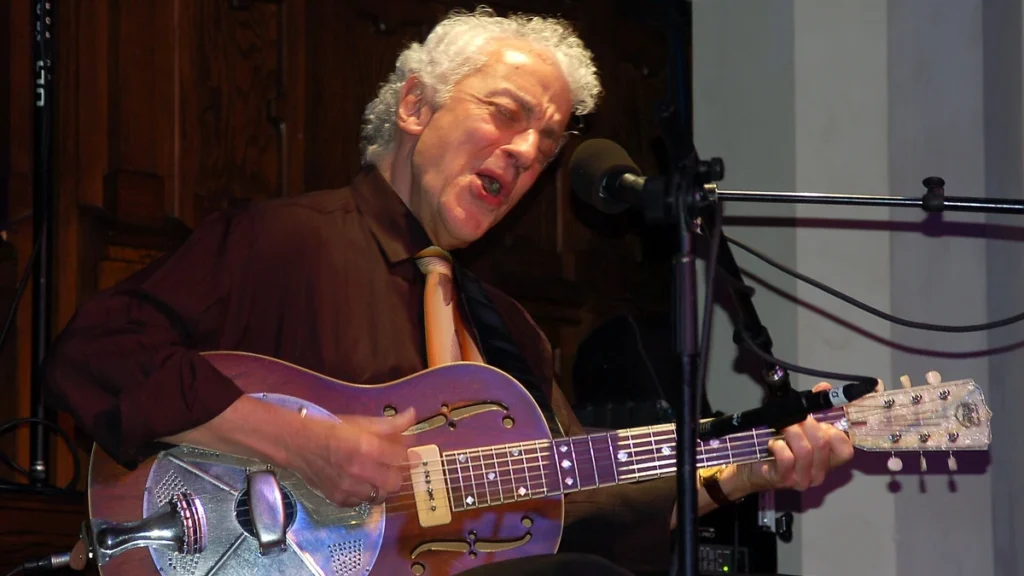
Doug MacLeod performing with a resonator guitar.
Doug MacLeod performing with a resonator guitar.
Doug MacLeod has been repeating the same sentence for most of fifty years, because a man in Toano, Virginia gave it to him and it turned out to be the whole job. “He instilled in me the honesty,” MacLeod says of his mentor Ernest Banks. “He told me: never write or sing about what you don’t know about and never play a note you don’t believe.”
That rule produced Between Somewhere and Goodbye, which took Acoustic Blues Album at the 47th Blues Music Awards in Memphis in May. It is his sixth record for Reference Recordings and somewhere near his thirtieth overall.
An Acoustic Blues Album Made in Nashville
The award category says acoustic; the credits say Nashville. Andreas Werner produced at Creative Workshop, with Joe Funderburk engineering, and the eleven tracks run about forty-seven minutes. That is not the shape a purist acoustic blues record usually takes.
Blues Blast Magazine lists the band: Paul Ossola on bass, Mark T. Jordan on piano, Wurlitzer and B3, Lynn Williams on drums. Collectively they are known as the Funky Chester Rhythm Section, and their credits run through Bonnie Raitt, Delbert McClinton, Van Morrison and Lyle Lovett.
A rhythm section with that history behind a solo blues writer is the record’s central decision. It keeps the guitar and the voice in front — MacLeod’s playing is still the lead instrument throughout — while giving the songs a floor to stand on that a solo performance cannot provide.
The award category is worth defending on this point. Acoustic, in the Blues Foundation’s usage, describes the instrument at the centre of the record rather than a prohibition on everything else. MacLeod plays acoustic and resonator guitar throughout and the songs are built on them; a bass, a piano and a set of brushes do not change what the record is.
Werner is on the album as well, playing acoustic and rhythm guitar on two tracks, which is an unusual amount of visibility for a producer on a record credited to a solo artist. It suggests the sessions were run as a band date rather than as an overdub exercise, which is consistent with how quickly the arrangements settle.
The Shoals Sisters and the Soul Underneath
Cindy Richardson Walker, Marie Tomlinson Lewey and Carla Russell sing harmony as the Shoals Sisters, and their presence explains the album’s other departure. MacLeod’s own liner note is candid about it: this album is a little different from his others, with blues, humour and even a touch of soul in it, and a theme running through many of the songs.
They are used most audibly on “Memphis In Your Soul”, the opener, and on the 2025 re-recording of “Roll Like a River”. Gospel-derived harmony behind a country blues singer is an old combination that fell out of use when the two markets separated, and hearing it restored is the record’s most immediately pleasurable quality.
It also solves a practical problem for a writer with more than four hundred songs behind him. A voice as familiar as MacLeod’s benefits from something to answer it, and three singers give the arrangements somewhere to build to without adding volume.
Eleven Songs and a Theme
The sequence runs “Memphis In Your Soul”, the title track, “Keep On Walking On”, “Hard Times”, “Roll Like A River 2025”, “I Ain’t No Stranger”, “One Rib Short”, “The Seen And The Unseen”, “Even Angels Get Too Sad To Fly”, “I Don’t Like Your Chances” and “Watching The Sun Go Down”.
Blues Roadhouse reads the opener as a direct response to MacLeod’s move to Memphis in 2019 — a song about the city and the river rather than about arriving in either. “Hard Times” is down-home and downhearted; “Keep On Walkin’ On” is hopeful; the title track is moody.
The humour is real and load-bearing. “One Rib Short” runs a piece of Adam-and-Eve wordplay across a traditional blues rhythm, and “I Don’t Like Your Chances” is a whimsical marital warning. Blues records that can be funny without becoming novelty records are rarer than they should be.
That balance is the sequencing’s actual job. Three consecutive songs about hard times would sink the record; three consecutive jokes would trivialise it. Alternating them — “Hard Times” at four, the river song at five, the rib joke at seven — keeps a listener from settling into either mode, which is the oldest trick in a live blues set and works the same way on tape.
“Roll Like a River 2025” is the one re-recording, and revisiting an older song thirty years on is a fair test of whether the new band was the right choice. A writer with four hundred songs behind him has plenty to choose from, and picking that one signals the album’s preoccupation with moving water.
The Songs About Seeing
“The Seen and the Unseen” gives the Roadhouse review its headline and is the clearest statement of the theme MacLeod mentions in the notes. It is a mystical piece, closer to a vision than a narrative, and it sits at track eight where an album of this kind usually starts winding down.
“Even Angels Get Too Sad to Fly” is about letting go and carries what Blues Blast calls a contemporary, Nashville feel — the one moment the recording location shows through the writing. “I Ain’t No Stranger” takes an ethereal turn.
The closer, “Watching the Sun Go Down”, came out of walking along the Mississippi. It is quiet, and both reviews single it out. Ending an album of blues, jokes and visions on a man watching a river is not subtle, but after ten songs it has been earned.
What Kind of Blues This Actually Is
MacLeod is not from the Delta and has never pretended otherwise. He came to this music through two mentors — Ernest Banks in Virginia and the harmonica player George “Harmonica” Smith — and he has spent a career in the acoustic country-blues idiom that the Delta produced rather than in the Delta itself.
That distinction matters and it is one the blues has always handled well. The tradition transmits by apprenticeship rather than geography, which is precisely how John Primer carried the Mississippi sound to Chicago and why the Blues Foundation gives an acoustic award at all.
Smith taught him the other half. A harmonica player of that generation carried the Chicago band idiom, and the combination — Banks’s rural songwriting discipline, Smith’s ensemble instincts — explains why MacLeod can put a soul rhythm section behind an acoustic guitar without the record sounding confused about itself.
His move to Memphis in 2019 completed the geography. He had spent decades in California, and relocating to the city where the Blues Music Awards are held put him inside the tradition’s institutional centre rather than merely in correspondence with it. The album’s opening song is about that arrival, or more precisely about the river he found when he got there.
Banks’s rule is the mechanism. A writer forbidden from singing about what he does not know cannot borrow a biography, so what he produces is his own life in a borrowed form. Fifty years and four hundred songs later, that has turned out to be a durable way to work.
It is also, quietly, an argument about what an award for acoustic blues is supposed to reward. Not the absence of a drummer, but the presence of a person — one voice, one guitar, and a rule about honesty that a man in Virginia handed over and MacLeod has never seen a reason to put down.
About The Author

 Maybe Magic by Ryan Sweezey and a Decade of Unfinished Songs: The Long Version
  Where Deep Blue Sea Came From: Kadi Beth and a Mayday Call Over Dark Water
  Backyard Getaway by Emily Fraser, a Pop-Country Escape: The Long Version
  Why New Orleans Blues Rock Survived the Move to Switzerland on Rising by Jeb Rault
  Where I Asked Jesus & He Said No Came From: The Martha Groves Perry and Pat Thrall Protest Single
  Brandi Carlile’s Ted Lasso Theme Is the First Sung by a Woman