
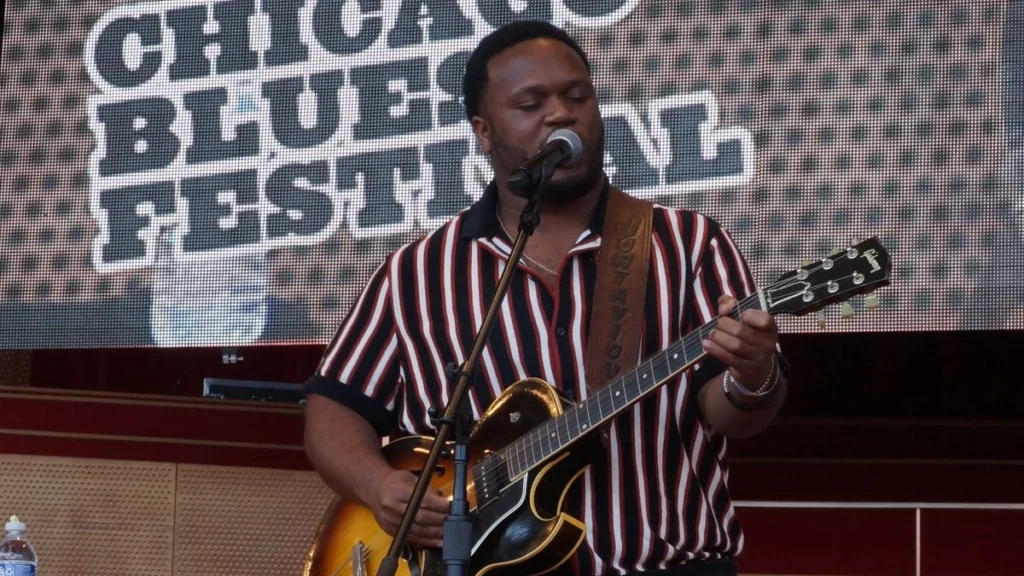
Jontavious Willis performing at the Chicago Blues Festival.
Jontavious Willis performing at the Chicago Blues Festival.
The Traditional Blues Male Artist ballot at this year’s Blues Music Awards reads Billy Branch, Rick Estrin, John Primer, Jimmie Vaughan — and Jontavious Willis, who was born in 1996.
Four of those men have been recording since before the fifth was alive. Putting them in one category is either an act of confidence in the young man or a demonstration of how narrow the traditional field has become. It is probably the first.
The Category and What It Contains
Blues Rock Review published the full nominee list for the 47th ceremony, held in Memphis on 7 May. The same slate carried Buddy Guy in Traditional Blues Album, Rhiannon Giddens in two categories, and Doug MacLeod in the acoustic pair.
Traditional Blues Male Artist is not a lifetime-achievement category, and it is not an emerging-artist one either. It is a straight assessment of who is playing the older idiom best right now, which is precisely why Willis’s inclusion matters more than a nomination in a young-artist bracket would.
John Primer’s presence on the same ballot makes the point sharper. Primer learned the music in Mississippi and carried it to Chicago through Muddy Waters’s band; his birthplace marker was approved this year. He is the transmission line, and Willis is what the line has produced.
Fifteen Songs He Produced Himself
West Georgia Blues came out on 16 August 2024 through Strolling Bones Records: fifteen original songs, self-produced. That last detail is the striking one. His previous album had Taj Mahal as executive producer and Keb’ Mo’ at the desk, and for the follow-up he did it alone.
The album announcement describes a record about heartbreak, loneliness, celebration and self-discovery, handled with humour, drawing directly on the traditions of rent parties and juke joints — music made for a room where people are dancing rather than listening.
That framing matters for a traditionalist. The country blues is usually presented as a solitary, mournful form, largely because the recordings that survived were made by one man in front of one microphone. The rent party was the actual social context, and building an album around it is a corrective rather than a novelty.
Fifteen original songs is the other number worth pausing on. A young artist in a revival idiom has an easy route available — record the standards, play them well, and let the repertoire carry the credibility. Writing the whole record forgoes that protection entirely and invites comparison with the songs he is not playing.
Self-producing compounds the risk. There is nobody to blame for a thin arrangement and nobody to talk him out of a bad take, which is a lot of exposure for a third album. It is also the only way to find out what his records sound like when they are not being shaped by two very distinctive elder producers.
Being Called a Wunderkind at Nineteen
Taj Mahal invited Willis onstage in 2015 and afterwards called him “my Wonderboy, the Wunderkind”. Willis has spent the decade since making that description into something other than a burden, which is harder than it sounds.
The evidence is in the sequence. Blue Metamorphosis, self-released in 2017, won the Blues Foundation’s International Blues Challenge award for Best Self-Produced CD. Spectacular Class followed in 2019 on Kind of Blue Music, produced by Keb’ Mo’ with Taj Mahal executive-producing, and took a Grammy nomination for Best Traditional Blues Album while reaching No. 12 on the Billboard blues chart.
The harmonica player Paul Oscher put the endorsement in the most consequential terms available: “this is how the blues, as I know it, is going to stay alive.”
The Banjo in the Case
Willis plays vocals, guitar, harmonica and banjo, and the last of those is the one that complicates his genre. A banjo in the hands of a Black country blues musician from rural Georgia is not a crossover instrument; it is the older arrangement, restored.
The instrument arrived in America from West Africa and was central to Black southern music long before it became shorthand for white Appalachian string bands. Musicians of the songster generation moved between blues, ballads, dance tunes and reels without regarding them as separate repertoires, and that is the tradition a four-instrument player is working in.
It puts Willis on the same ground Rhiannon Giddens has spent a career documenting — which is presumably why she appears twice on the same awards ballot, in Acoustic Blues Artist and Traditional Blues Female Artist. The categories are blues; the actual music predates the category system entirely.
The harmonica does similar work in the other direction. It is the instrument that carries the Chicago electric tradition, and two of his fellow nominees — Billy Branch and Rick Estrin — are harmonica players first. A guitarist who also plays it is claiming a wider inheritance than his own region’s.
None of this is antiquarianism. A musician who can move between four instruments is simply better equipped for the kind of night the rent-party framing describes, where the room wants a dance tune, then a ballad, then something funny, and the band is one person.
Greenville, Georgia, Named on the Sleeve
He is from Greenville, in west Georgia, and the album says so on the cover. Naming a region rather than a city is a specific choice — it claims a rural tradition rather than a scene, and west Georgia has no blues brand to trade on the way the Mississippi Delta or the South Side of Chicago do.
That absence is the point. The country blues was not confined to the Delta; it was played across the whole rural South, and the geography of the recording industry rather than the geography of the music decided which places became famous. An album called West Georgia Blues is quietly correcting the map.
It also explains the self-production. An artist making a record about a place with no established sound has nobody to imitate, and the fastest route to something that sounds like west Georgia is to have the person from there make every decision.
What the Ballot Actually Says
Whatever the envelope said on the night, the nomination is the interesting result, because it places a man not yet thirty in a straight comparison with four musicians who learned this music from the generation that invented it.
Awards in a small field are a flawed instrument, and the blues field is small. But a nominating body drawn from the people who play and present this music does not put a young artist on that particular list out of politeness — the young-artist categories exist precisely so it does not have to.
The same ceremony gave Acoustic Blues Album to Doug MacLeod, who is working from a rule his mentor gave him in Virginia — a reminder that the blues has always transmitted person to person rather than through institutions.
Willis is on the receiving end of two of those transmissions, from Taj Mahal and Keb’ Mo’, and the ballot suggests the transfer took. Whether he is the future of the form is not a question a nomination answers. That he is currently one of the five best people doing it is.
The more useful measure will be the next record. A self-produced album of original songs from a musician who has now been publicly compared to the elders of his own idiom either builds on that or does not, and unlike an awards ballot, it is entirely his to decide.
About The Author

 Miko Marks Opens Hell Or High Water at the Little Bighorn
  Hot Club of Cowtown Answered a Village Voice Ad and Stayed Thirty Years
  Marty Stuart Made a Surf Guitar Album on Clarence White’s Telecaster
  Turnpike Troubadours Covered Robert Earl Keen With Sierra Hull
  Jason Isbell Made an Album Alone With a 1940 Martin in Five Days
  HARDY Answered His Rock Detour With an Album Called Country! Country!